
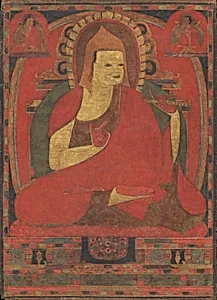
Portrait of the Indian Monk Atisha
Unknown Artist
early to mid-12th century
Medium
Distemper and gold on cloth
Dimensions
Image: H. 19 1/2 in. (49.5 cm); W. 15/16 in. (35.4 cm) Framed: H. 32 13/16 (83.3 cm); W. 21 11/16 in. (55.1 cm); D. 1 in. (2.5 cm); Wt. 9 lbs. (4.1 kg)
Classification
Paintings
Culture
Tibet
Department
Asian Art
Museum
Metropolitan Museum of Art, New York, NY
Credit
Gift of Steven Kossak, The Kronos Collections, 1993
Accession Number
1993.479
Rights
Public Domain
Tags
Art Historical Context
This striking *Portrait of the Indian Monkisha*, created by an unknown Tibetan artist in the early to mid-th century, captures the revered Buddhist master who played a pivotal role in revitalizing Tibetan Buddhism. Atisha (982–1054 CE), born in India, traveled to Tibet at the invitation of its rulers, founding the Kadampa tradition and synthesizing Indian and local practices. His teachings emphasized compassion and the bodhisattva path, influencing generations of Tibetan monks and lamas. Displayed in the Metropolitan Museum of Art's Asian Art department, this painting exemplifies early Tibetan devotional art, gifted by Steven Kossak in 1993. Crafted in distemper—a glue-based paint—and adorned with gold on cloth, the portrait employs techniques typical of thangka traditions, where vibrant pigments and metallic highlights create a luminous, sacred aura. The modest dimensions (image: 19½ × 15/16 inches) suggest it was likely a portable altar piece for personal meditation or teaching. Gold detailing on Atisha's robes and halo symbolizes enlightenment and divine presence, inviting viewers to contemplate his wisdom amid Tibet's rich Buddhist heritage. A testament to cross-cultural exchange, it bridges Indian origins with Tibetan artistry.