
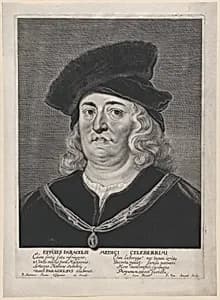
Portrait of Theophrastus Paracelsus
Medium
Engraving; first state of two (Hollstein)
Dimensions
Plate: 12 1/16 × 8 11/16 in. (30.7 × 22 cm) Sheet: 13 7/16 × 9 13/16 in. (34.2 × 24.9 cm)
Classification
Prints
Department
Drawings and Prints
Museum
Metropolitan Museum of Art, New York, NY
Credit
Harris Brisbane Dick Fund, 1928
Accession Number
28.7.4
Rights
Public Domain
Tags
Art Historical Context
This striking engraving, *Portrait of Theophrast Paracelsus*, the likeness of the renowned 16th-century Swiss physician, alchemist, philosopher Philippus Aureolus Theophus Bombastus von Hheim—better known as Paracels. Created between 1615 and 1643, it reflects the posthumous fascination with his revolutionary ideas on medicine and natural philosophy during the Baroque era. Attributed to a collaborative effort involving eminent Flemish artists Pieter van Sompel, Pieter Soutman, and Peter Paul Rubens, the print likely draws from Rubens' dynamic style, known for its dramatic realism and vitality, adapting it to the intimate scale of portraiture. As a first-state engraving from Hollstein's catalog—one of just two states—this rare print exemplifies the technical precision of 17th-century printmaking. The meticulous lines and shading on the 12 1/16 × 8 11/16-inch plate convey Paracelsus' intense gaze and scholarly attire, making his image accessible beyond paintings. Housed in the Metropolitan Museum of Art's Drawings and Prints department, acquired via the Harris Brisbane Dick Fund in 1928, it highlights how engravings democratized portraits of intellectual giants, bridging Renaissance humanism with Baroque grandeur. Visitors will appreciate how this work immortalizes Paracelsus' enduring legacy, blending historical reverence with artistic innovation in a format that once circulated widely among Europe's learned elite.