
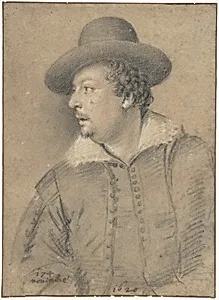
Portrait of Tommaso Salini (ca. 1578-1630)
Medium
Black chalk and charcoal, red chalk, white chalk on brown paper (faded from blue?). Framing lines in pen and brown ink
Dimensions
8 7/8 x 6 7/16 in. (22.6 x 16.4 cm)
Classification
Drawings
Department
Drawings and Prints
Museum
Metropolitan Museum of Art, New York, NY
Credit
Gift of Mrs. Charles Slatkin, 1954
Accession Number
54.612.1
Rights
Public Domain
Tags
Art Historical Context
In the vibrant artistic circles of early 17th-century Rome Ottavio Leoni (1578–1630), known as "Ilovano," captured the likeness of fellow artist Tommaso Salini (ca 1578–1630) in this intimate 1620 portrait drawing. Leoni, a master portraitist celebrated for his precise yet expressive chalk studies of Roman intellectuals, nobility, and painters, immortalized Salini—a Caravaggesque still-life specialist and member of Caravaggio's contentious circle—during a time when dramatic tenebrism and naturalism dominated Italian art. Executed on brown paper (possibly faded from blue), the work employs a sophisticated blend of black chalk and charcoal for deep shadows, red chalk for warm flesh tones, and white chalk for highlights, creating a luminous chiaroscuro effect that models Salini's thoughtful face with remarkable three-dimensionality. Delicate framing lines in pen and brown ink add a refined finish, underscoring Leoni's role in elevating preparatory drawings to independent artworks prized by collectors. This 8⅞ × 6⅞-inch gem, now at the Metropolitan Museum of Art, offers a window into Baroque Rome's interconnected artist community, where portraits like this preserved personal legacies amid the era's artistic rivalries and innovations. A testament to chalk's versatility, it invites visitors to appreciate the subtle power of monochrome mastery.