
Portrait of Two Boys
c. 1870s
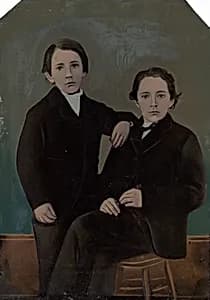
Medium
tintype with applied color
Dimensions
image/plate: 25.7 x 18 cm (10 1/8 x 7 1/16 in.)
Classification
Photograph
Department
CPH
Museum
National Gallery of Art, Washington, D.C.
Credit
Gift of Mary and Dan Solomon and Patrons' Permanent Fund
Accession Number
2006.133.133
Rights
Public Domain
Art Historical Context
**Portrait of Two Boys**, created by an anonymous American photographer around the 1870s, captures innocence and formality of childhood in post-Civil War America. tintype, a direct-positive image on a thin iron plate, measures 25.7 x 18 cm and exemplifies the era's accessible photography. Tintypes, invented in the 1850s, democratized portraiture, allowing families from all walks of life to preserve memories affordably—often posed stiffly in studios with props like chairs or backdrops to convey respectability. The subtle applied color enhances the boys' cheeks, lips, and clothing, a popular hand-tinting technique that brought monochrome images to life, blending photography's precision with painting's warmth. This medium's portability made it ideal for traveling photographers serving rural communities, reflecting a burgeoning middle-class desire for personal documentation amid rapid industrialization. Housed in the National Gallery of Art's Department of Photographs (CPH) through the generous gift of Mary and Dan Solomon and the Patrons' Permanent Fund, this work highlights vernacular photography's role in everyday American history. It invites us to ponder the unnamed subjects' stories—perhaps brothers or friends—frozen in a moment of quiet dignity, offering a poignant glimpse into 19th-century family life.
About the Artist
American 19th Century · 1800–1900
The artist cataloged as "American, 19th Century" represents a collective of unidentified painters active in the United States during the nineteenth century, with 380 known artworks preserved in this virtual museum's collection. These works span a diverse array of genres typical of the era, including portraits, landscapes, still lifes, and genre scenes, reflecting the burgeoning artistic output of ...