
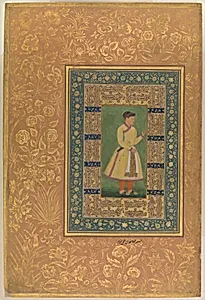
"Portrait of Zamana Beg, Mahabat Khan", Folio from the Shah Jahan Album
recto: ca. 1610; verso: ca. 1530–40
Medium
Ink, opaque watercolor, and gold on paper
Dimensions
H. 15 1/4 in. (38.7 cm) W. 10 5/16 in. (26.2 cm)
Classification
Codices
Department
Islamic Art
Museum
Metropolitan Museum of Art, New York, NY
Credit
Purchase, Rogers Fund and The Kevorkian Foundation Gift, 1955
Accession Number
55.121.10.3
Rights
Public Domain
Tags
Art Historical Context
This folio from the Shah Jahan Album pairs a striking Mughal portrait with elegant Persian calligraphy, reflecting the refined tastes of the imperial court in early seventeenth-century India. Painted around 1610 by the artist Manohar, the recto depicts Zamana Beg, better known as Mahabat Khan, a prominent military commander who served emperors Jahangir and Shah Jahan. Shown in profile with a neatly trimmed beard and ornate turban, the general embodies the dignity and authority expected of high-ranking Mughal nobles. The verso, created decades earlier by the celebrated calligrapher Mir ‘Ali Haravi, adds a layer of historical depth, illustrating how albums assembled under Shah Jahan often combined works from different periods to create visual dialogues across time. Executed in ink, opaque watercolor, and gold on paper, the portrait exemplifies the meticulous techniques of Mughal painting. Fine brushwork captures the textures of fabric, jewelry, and facial features with remarkable precision, while the use of gold heightens the subject’s status. Such single-figure studies were prized for their ability to convey both likeness and inner character within a compact format. As part of a larger album now in the Metropolitan Museum’s collection, this folio offers visitors a window into the cosmopolitan world of Mughal patronage, where art, history, and power intersected on the page.