
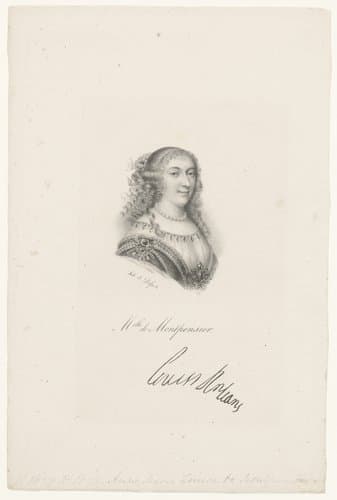
Portret van Anne-Marie-Louise d'Orléans
in of na 1818 - in of voor 1842
Medium
lithography
Dimensions
181; 272
Rights
Public Domain
About this artwork
blad: hoogte 272 mm x breedte 181 mm
Art Historical Context
This delicate lithograph, titled *Portret van Anne-Marieouise d'Orléans captures the poised elegance of one of France's most intriguing 17th-century nobles: Anne Marie Louise d'Or (1627–1693), known as "La Grande Mademoiselle." The daughter of Gaston d'Orléans and a cousin of Louis XIV, she was the wealthiest unmarried woman in Europe, renowned for her wealth, intellect, and bold participation in the Fronde rebellion against the young king. Created anonymously but attributed to veuve Delpech (Naudet)—likely the widow of Parisian lithographer François Séraphin Delpech—this posthumous portrait dates to between 1818 and 1842, measuring 272 mm high by 181 mm wide. Lithography, the innovative medium here, revolutionized printmaking in the early 19th century. Invented around 1798, it allowed artists to draw directly on limestone with greasy crayon, producing affordable, detailed reproductions from a single stone—ideal for disseminating images of historical figures during the Romantic era's fascination with the ancien régime. This technique's subtle tonal gradations lend the portrait a lifelike softness, evoking the subject's legendary beauty and grandeur. Displayed in museum collections, this print reflects a cultural revival of pre-Revolutionary aristocracy, bridging 17th-century opulence with 19th-century nostalgia. A testament to lithography's democratic power, it invites visitors to ponder La Grande Mademoiselle's defiant spirit through an accessible artistic lens.