
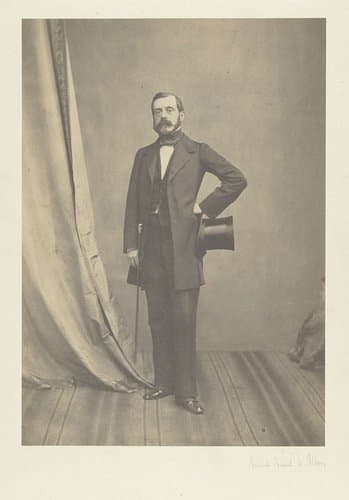
Portret van burggraaf Raoul d'Albon
1851 - 1860
Medium
salted paper print
Dimensions
234; 201; 283; 331
Rights
Public Domain
About this artwork
height 331 mm x width 234 mm
Art Historical Context
Step into the dawn of photography with *Portret van burggraaf Raoul d'Albon*, an anonymous salted paper print from around 1851-1860. This intimate portrait captures Viscount Raoul d'Albon, a French noble from the historic Dauphiné region, rendered in soft tones on a sheet measuring 283 mm high by 201 mm wide (mounted to 331 mm x 234 mm). The title, in Dutch, hints at its possible circulation in the Low Countries, reflecting the rapid spread of this new medium across Europe. Salted paper prints, pioneered by William Henry Fox Talbot in the 1840s, represent a pivotal moment in art history. Unlike daguerreotypes, which produced unique images, this calotype-derived process used a paper negative to create multiple positive prints by sensitizing paper with salt and silver nitrate. Exposed to light and developed in gallic acid, it yielded the subtle, painterly gradations seen here—warm highlights and delicate shadows that evoke 19th-century portrait painting traditions. Captured during photography's formative years, this work underscores the technology's swift embrace by aristocracy, immortalizing d'Albon's dignified gaze amid social change. As an anonymous piece, it embodies the era's amateur and studio experimentation, bridging fine art and science for everyday wonder.
About the Artist
anonymous
In the vast tapestry of art history, "Anonymous" stands not as a singular individual but as a collective designation for countless unidentified creators whose works have endured across millennia. These artists, spanning prehistoric cave painters to medieval illuminators and folk craftsmen, produced the foundational layers of human visual culture. Prior to the Renaissance, when individual fame emer...