
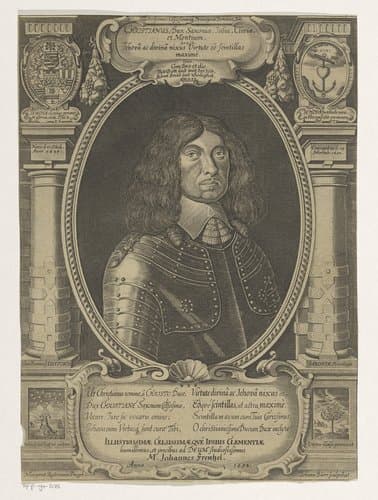
Portret van Christian I van Saksen
1654
Medium
engraving
Dimensions
216; 299
Rights
Public Domain
About this artwork
verzamelaarsmerk, verso, gestempeld: Lugt 2228
Art Historical Context
This engraving, created by the German artist Johann Dürr in 1654, presents a formal portrait of Christian I of Saxony. Measuring nearly 30 centimeters in height, the work exemplifies the precision and detail achievable through the engraving technique, which involves incising lines into a metal plate to produce multiple impressions. Such prints played a vital role in 17th-century Europe, allowing portraits of nobility to circulate beyond court circles and reach a broader audience of collectors and scholars. The presence of a collector’s stamp on the reverse (Lugt 2228) hints at the print’s journey through private collections, underscoring its value as both a historical document and an object of connoisseurship. Dürr’s measured approach to line work captures the dignity and status associated with Saxon rulers, reflecting the era’s emphasis on dynastic imagery. As a reproductive medium, engraving helped preserve and disseminate likenesses long after the sitter’s lifetime, bridging personal memory with public history. This example offers visitors a glimpse into how 17th-century artists balanced technical skill with the demands of aristocratic representation.
About the Artist
Johann Dürr · 1600–1663
Johann Dürr (1600–1663) was a German copperplate engraver who worked primarily in Weimar during the mid-17th century, producing prints for court and scholarly patrons during the tumultuous period of the Thirty Years' War. Born in 1600, Dürr's career spanned one of the most devastating periods in German history, when religious conflict and military campaigns brought widespread destruction to German...