
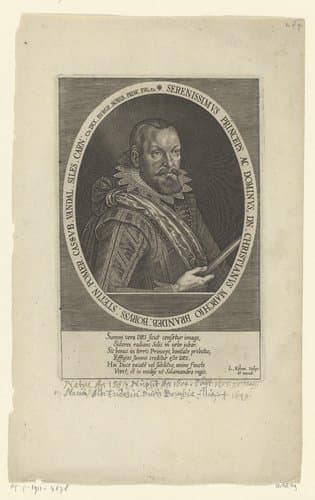
Portret van Christian von Brandenburg-Kulmbach
1603 - 1637
Medium
engraving
Dimensions
138; 204
Rights
Public Domain
About this artwork
plaatrand: hoogte 204 mm x breedte 138 mm
Art Historical Context
**Portret van Christian von Brandenburg-Kulach** is a finely executed engraving by Lucas Kilian, prominent German artist from the renowned Kilian family of engr in Augsburg. Active in the early 17th century ( 1603–1637), Kilian specialized in detailed portrait prints that captured the likeness and status of Europe's nobility. This small-scale work, measuring 204 mm high by 138 mm wide, exemplifies the precision of Renaissance-era printmaking, where engravings served as affordable yet elegant reproductions of elite portraits. The subject, Christian von Brandenburg-Kulmbach, hails from a distinguished branch of the Hohenzollern dynasty, rulers of the Margraviate of Brandenburg-Kulmbach in the Holy Roman Empire. Created during a turbulent period leading into the Thirty Years' War, the portrait reflects the era's emphasis on dynastic prestige and identity. Kilian's technique—incising lines into a metal plate with a burin—allowed for intricate shading and texture, making high-quality impressions that could be widely distributed to affirm the sitter's power and piety. As a testament to early Baroque portraiture, this engraving highlights printmaking's cultural role in disseminating imagery beyond oil paintings reserved for the wealthy. Visitors will appreciate its intimate scale, inviting close inspection of the delicate line work that brings history to life.
About the Artist
Lucas Kilian · 1579–1637
Lucas Kilian (1579–1637) was one of the most celebrated engravers of early 17th-century Germany and the most prominent member of the Kilian dynasty of printmakers in Augsburg. Born in Augsburg in 1579, Lucas Kilian achieved international recognition for his technically virtuosic engravings and became a leading figure in the transition from late Renaissance to early Baroque printmaking styles. His ...