
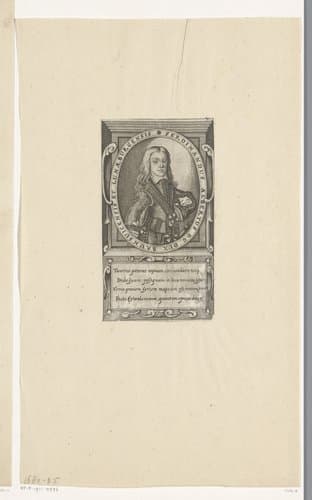
Portret van Ferdinand Albrecht I von Braunschweig-Wolfenbüttel-Bevern
1649
Medium
engraving
Dimensions
73; 132
Rights
Public Domain
About this artwork
Prent afkomstig uit: Andreä, Johann Valentin. Seleniana augustalia (...). Ulm: Balthasar Kuhn, [1649].
Art Historical Context
**Portret van Ferdinand Albrecht I Braunschweig-Wolfüttel-BevernThis delicate engraving by Conrad Buno captures the youthful likeness of Ferdinand Albrecht I von Braunschweig-Wolfüttel-Bevern, a noble from the prominent House of Welf in17th-century Germany. Created in 1649 when Ferdinand was just 17, the portrait measures a modest 132 mm high by 73 mm wide, showcasing Buno's skill as a German engraver known for precise, detailed reproductive prints. It originates from Johann Valentin Andreä's *Seleniana augustalia*, published in Ulm by Balthasar Kuhn that same year—a rare work blending theology, emblematics, and noble panegyric by the influential Lutheran scholar Andreä. Engravings like this were vital in the Baroque era for disseminating images of aristocracy across Europe, allowing widespread admiration of ruling figures without the need for costly paintings. Buno's technique—incising fine lines into a copper plate with a burin—produced rich tonal contrasts and intricate details, from Ferdinand's lace collar to his resolute gaze, evoking the era's emphasis on status and lineage. As a printed portrait in a scholarly volume, it reflects the cultural interplay of art, politics, and intellect during the post-Thirty Years' War recovery, immortalizing a future duke in an accessible format for collectors and courts alike.