
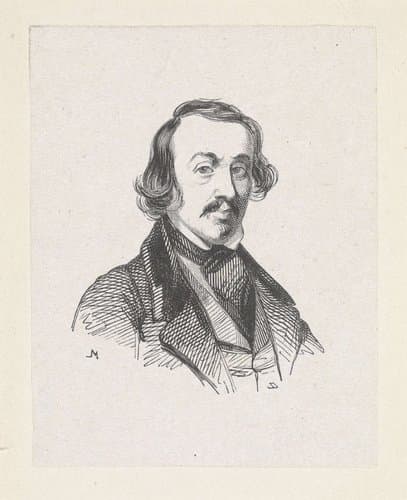
Portret van Hendrik Gerrit ten Cate
Medium
wood engraving
Dimensions
41; 48
Rights
Public Domain
About this artwork
hoogte 48 mm (voorstelling gemeten) x breedte 41 mm
Art Historical Context
Behold the delicate *Portret van Hendrik Gerrit Cate* (1842), a diminutive wood engraving by the enigmatic Monogrammist from Germany. Measuring just 48 mm by 41 mm wide—capturing the image precisely within these bounds—this tiny portrait exemplifies the precision of 19th-century printmaking. Wood engraving, a technique where fine lines are incised into the end-grain of hardwood blocks, allowed for intricate details and mass reproduction, making it ideal for book illustrations, vignettes, or collectible portraits during the Industrial era. Created in 1842, this work captures Hendrik Gerrit ten Cate, a notable Dutch figure likely from the burgeoning textile industry in the Netherlands. The mid-19th century saw rapid advancements in engraving, bridging Romantic portraiture with emerging photographic realism, as artists like Monogrammist M produced affordable likenesses for a wider audience. The monogrammed signature hints at a specialized craftsman, possibly working in a German workshop known for exporting prints across Europe. Its cultural significance lies in preserving personal histories through accessible art. In an age of industrialization, such micro-portraits democratized portraiture, turning everyday notables into visual legacies. A charming gem for collectors, it invites us to marvel at the artistry packed into a space smaller than a postage stamp.