
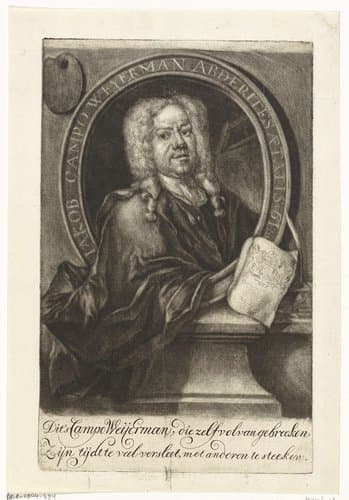
Portret van Jakob Campo Weyerman
1698 - 1776
Medium
engraving
Dimensions
218; 139
Rights
Public Domain
About this artwork
mezzotint en gravure
Art Historical Context
Behold the *Portret van Jakob Campo Wey*, a finely crafted engraving by Dutch artist Johannes de Groot (II), active from 1698 to 1776. This intimate portrait captures Jakob Campo Weyerman (1677–1747), a colorful figure in Dutch cultural life—a painter, prolific writer, biographer of artists, and art dealer whose lively *Levensbeschryvingen der Nederlandsche Konstenaars* chronicled the era's creative luminaries. Created in the early 18th century, it reflects the enduring Dutch tradition of portraiture, where prints like this made prominent personalities accessible to a wider audience beyond oil paintings. De Groot employs a masterful combination of *mezzotint* and traditional *gravure* (line engraving), techniques that shine in this compact format of 218 × 139 mm. Mezzotint, pioneered in the late 17th century, involves roughening a copper plate to hold deep blacks and velvety tones, then scraping highlights for luminous effects—ideal for conveying Weyerman's expressive face and textured attire. This hybrid approach blends the tonal richness of mezzotint with the precise lines of engraving, showcasing the technical innovation of Dutch printmaking during the post-Golden Age. As a cultural artifact, this engraving preserves Weyerman's legacy amid the vibrant Amsterdam art scene, where prints fueled intellectual exchange and celebrity. A testament to engraving's democratic power, it invites us to ponder the interconnected lives of artists in an age of enlightenment and portrait mania.