
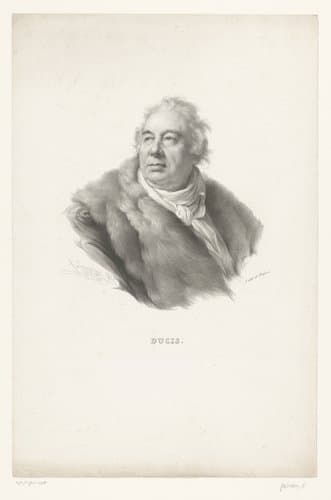
Portret van Jean-François Ducis
1825
Medium
lithography
Dimensions
329; 500
Rights
Public Domain
About this artwork
blad: hoogte 500 mm x breedte 329 mm
Art Historical Context
Henri Grévedon’s *Portret van Jean-François Ducis*1825) is a lithograph capturing the likeness of the esteemed French poet and dramatist-François Ducis (1733–1816). Measuring 500 mm high by 329 mm wide, this sheet-sized print exemplifies the early 19th-century fascination with portraiture, likely created posthumously to honor Ducis’s legacy. Grévedon, a prominent French artist known for his elegant lithographic works, renders the subject with a refined sensitivity, highlighting Ducis’s thoughtful expression against a simple backdrop. Lithography, the medium here, revolutionized printmaking after its invention around 1798. By drawing with greasy crayon on a polished limestone slab, artists like Grévedon achieved fluid, painterly tones and subtle gradations impossible in earlier techniques like engraving. This made high-quality portraits affordable and widely distributable, democratizing access to images of cultural figures during the Romantic era’s rise. Culturally, the portrait reflects France’s neoclassical reverence for literary giants like Ducis, who adapted Shakespeare’s plays for French audiences. Displayed in a virtual museum, it invites us to ponder how such prints preserved intellectual heritage, bridging the gap between elite salons and everyday admirers.