
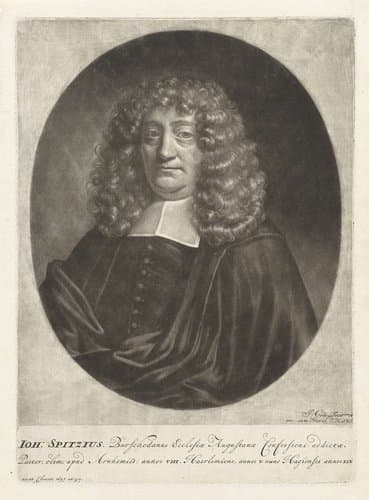
Portret van Johan Spitzius
1697
Medium
engraving
Dimensions
302; 219
Rights
Public Domain
About this artwork
mezzotint en gravure
Art Historical Context
**Portret van Johan Spitzius** a striking 1697 engraving by Dutch artist Jacob Gole, capturing the likeness of Johan Spitzius in a measuring 302 mm high by 219 mm wide. Created during the waning years of the Dutch Golden Age this portrait exemplifies the era's fascination with precise, reproducible imagery of prominent figures—likely scholars, merchants, or civic leaders like Spitzius himself. Gole, a reproductive engraver, specialized in translating paintings into prints, making elite portraiture accessible to a broader audience through affordable multiples. The artwork's medium—a combination of *mezzotint* and *gravure* (engraving)—highlights innovative 17th-century printmaking techniques. Mezzotint, pioneered in the 1640s, involves roughening a copper plate to create deep, velvety tones and subtle gradations, ideal for conveying the soft modeling of flesh and fabric in portraits. Gole's precise line work from engraving adds sharp details, blending tonal richness with clarity. This hybrid approach not only showcased technical virtuosity but also elevated prints from mere copies to standalone artworks. Culturally, such engravings preserved the images of influential individuals, fostering a visual record of Dutch society's intellectual and social elite. Today, *Portret van Johan Spitzius* invites us to ponder the face behind the name, bridging 300 years of history through Gole's masterful craft. (198 words)
About the Artist
Jacob Gole · 1660–1737
Jacob Gole (c. 1660-1737) was a Dutch engraver and mezzotinter renowned for his portrait engravings and his role in disseminating the mezzotint technique across Europe. Born in Paris to the celebrated Huguenot cabinetmaker Pierre Gole, he emerged as one of the most skilled printmakers of the late Dutch Golden Age. Gole's significance in art history lies primarily in his mastery of the mezzotint t...