
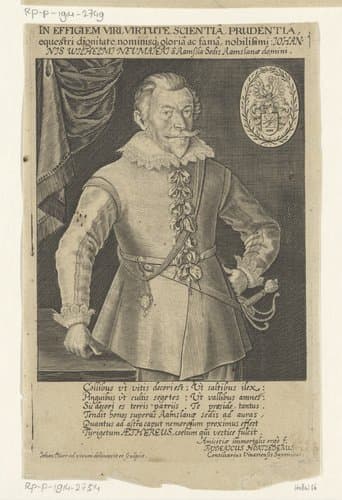
Portret van Johann Wilhelm Neumayr von Ramsla
1644 - 1663
Medium
engraving
Dimensions
102; 160
Rights
Public Domain
About this artwork
height 160 mm x width 102 mm
Art Historical Context
Nestled among our collection of 17th-century prints is *Portret van Johann Wilhelmumayr von Ramsla*, an exquisite engraving by Johann Dürr, between 1644 and1663. This intimate portrait measures just 160 mm high by 102 mm wide, perfectly suited for personal cabinets or albums of the era. Dürr, a skilled German engraver, captures the nobleman—likely a figure of regional aristocracy from the Holy Roman Empire—with a focus on conveying dignity and presence through meticulous line work. Engraving, the medium here, was a hallmark of Baroque printmaking. Artists like Dürr incised fine lines into a copper plate, inking it and pressing paper to produce detailed, reproducible images. This technique allowed portraits of elites to circulate widely among collectors, scholars, and courts, democratizing access to aristocratic likenesses during a time of post-Thirty Years' War recovery in Europe. Though compact, the work exemplifies the period's emphasis on portraiture as a tool for social identity and legacy. Visitors, imagine holding this piece in your hand—its precision invites close inspection, revealing Dürr's mastery in evoking character through shadow and texture. A gem for print enthusiasts!
About the Artist
Johann Dürr · 1600–1663
Johann Dürr (1600–1663) was a German copperplate engraver who worked primarily in Weimar during the mid-17th century, producing prints for court and scholarly patrons during the tumultuous period of the Thirty Years' War. Born in 1600, Dürr's career spanned one of the most devastating periods in German history, when religious conflict and military campaigns brought widespread destruction to German...