
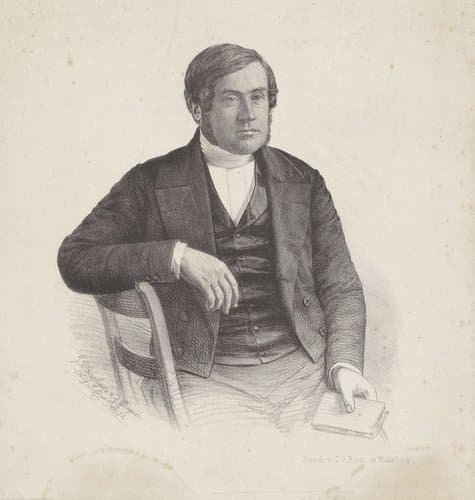
Portret van Johannes Petrus Hasebroek
1851-08-28
Medium
lithography
Dimensions
264; 230
Rights
Public Domain
About this artwork
De geportretteerde zit gedraaid op een stoel en steunt met zijn rechterarm op de rugleuning. Zijn linkerhand, met daarin een boek, rust op zijn bovenbeen.
Art Historical Context
### Portrait of Johannes Petrus Hasebroek Created in 1851 by German-Dutch lithographer Johann Berghaus, *Portret van Johannes Petrus Hasebroek captures the likeness of its subject in a thoughtful, introspective pose. Hasebroek sits turned on a chair, his right arm casually draped over the backrest, his left hand rests on upper thigh, cradling an open book. This composition evokes the image of a scholar or intellectual, emphasizing contemplation and learning amid the mid-19th-century's growing emphasis on portraiture for commemorating notable figures. Lithography, the medium here (264 × 230 mm), was a revolutionary printmaking technique perfected in the early 1800s, allowing artists like Berghaus to produce detailed, tonal reproductions from a single stone drawing. Unlike earlier engraving methods, it captured subtle textures and nuances—evident in the portrait's realistic rendering of fabric folds and expressive posture—making high-quality images accessible to a wider audience. Berghaus, active in the Netherlands, specialized in such portraits, blending German precision with Dutch portrait traditions. This work reflects 19th-century Europe's cultural shift toward democratizing art through prints, preserving Hasebroek's image for posterity. Whether he was a local dignitary or cleric (hinted by the book), it stands as a window into everyday intellectual life, inviting visitors to ponder the stories behind such intimate likenesses.