
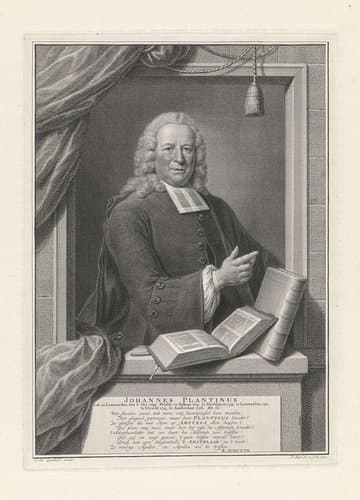
Portret van Johannes Plantinus op 61-jarige leeftijd
1752
Medium
engraving
Dimensions
254; 352
Rights
Public Domain
About this artwork
gravure en ets
Art Historical Context
In the heart of 18th-century Dutch art, Pieter Tanjé *Portret van Johannes Plant op 61-jarige leeftijd* (Portrait of Johannes Plantinus at 61 Years Old), created in 1752, the dignified likeness of its subject through the meticulous medium of engraving. Tanjé, a prominent Leiden-born engraver active in The Hague, was renowned for his precise reproductive prints and portraits that brought notable figures to life for a wider audience. Measuring 352 mm high by 254 mm wide, this work exemplifies the era's fascination with individualized portraiture during the Enlightenment, when scholars, merchants, and professionals sought lasting visual legacies. Crafted using a combination of engraving—incising fine lines into a copper plate with a burin—and etching, where acid bites into the metal for softer effects, the print showcases Tanjé's technical mastery. These intaglio techniques allowed for rich tonal contrasts and intricate details, from the subtle textures of clothing to the expressive lines of Plantinus's face, making high-quality reproductions possible at scale. Such methods were revolutionary, democratizing access to elite imagery beyond oil paintings reserved for the wealthy. This portrait holds cultural importance as a window into Dutch Golden Age afterglow, honoring Johannes Plantinus—likely a respected contemporary—at the mature age of 61. It reflects the period's emphasis on intellectual and civic virtue, inviting visitors to ponder the stories behind such finely rendered faces from history's quieter corners.