
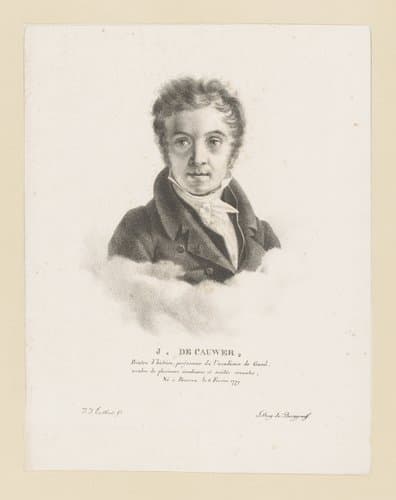
Portret van Joseph de Cauwer
Medium
lithography
Dimensions
301; 233
Rights
Public Domain
About this artwork
verzamelaarsmerk, verso, gestempeld: Lugt 2228
Art Historical Context
**Portret van Joseph de Cau** is a striking 1822 lithography by Guillaume Philidor Van denggraaff, measuring 301 mm high by 233 mm wide. This intimate portrait captures the likeness of Joseph de Cauwer likely a notable figure from early 19th-century Flemish or Dutch society, rendered with the precision characteristic of lithography's early adoption. Invented just two decades earlier by Alois Senefelder, this medium revolutionized printmaking by allowing artists to draw directly on stone with greasy crayon, producing multiple high-quality impressions that democratized art access beyond oil paintings. Van den Burggraaff, a skilled practitioner of this innovative technique, exemplifies lithography's role in portraiture during the Romantic era, when affordable prints proliferated among the growing middle class. The work's verso bears a collector's mark stamped Lugt 2228, signaling its provenance from a distinguished European collection and underscoring its enduring value to connoisseurs. Today, this piece invites us to appreciate how lithography bridged artistry and technology, preserving personal legacies with remarkable fidelity. A testament to 1820s cultural vibrancy, it reminds visitors of art's power to connect us across centuries.
About the Artist
Guillaume Philidor Van den Burggraaff · 1790–present
Guillaume Philidor van den Burggraaff (born 1790) was a Belgian lithographer and engraver who worked in Brussels during the early-to-mid 19th century, contributing to the documentation of Belgian street life and popular culture through his lithographic prints. Born in Brussels in 1790, van den Burggraaff held the title of lithographer to the Royal Academy, indicating official recognition and insti...