
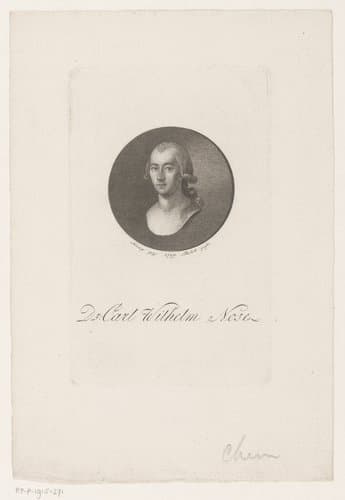
Portret van Karl Wilhelm Nose
Medium
etching
Dimensions
152; 95
Rights
Public Domain
About this artwork
collector's mark: Lugt 2228
Art Historical Context
**Portrait of Karl Wilhelm Nose** (1789) is a delicate etching by Ernst Karl Gottlieb Thelott a skilled German engraver known for his precise portrait work during the late Enlightenment era. Measuring just 152 mm high by 95 mm wide, this portrait captures the likeness of Karl Wilhelm Nose, likely a contemporary figure of note, rendered with fine lines that evoke the period's emphasis on rational observation and personal identity. Created at the cusp of the French Revolution, it reflects the era's fascination with individualized portraiture, bridging Rococo elegance and emerging Neoclassicism. As an etching, the artwork showcases Thelott's mastery of intaglio printmaking, where acid etches intricate lines into a metal plate, allowing for subtle tonal variations and textures through ink retention. This technique made high-quality reproductions accessible, democratizing portraiture beyond oil paintings reserved for the elite. The small scale suggests it was designed for private collections or albums, highlighting etching's role in disseminating images among scholars and patrons. Bearing the collector's mark Lugt 2228—evidence of its esteemed provenance—this piece underscores the enduring value of 18th-century prints in art history. Visitors will appreciate its technical finesse and glimpse into a world where a single etched face could preserve a legacy.
About the Artist
Ernst Karl Gottlieb Thelott · 1760–1834
Ernst Karl Gottlieb Thelott (1760–1834) was a German copperplate engraver and painter whose career spanned the transition from Enlightenment classicism to early Romanticism, working primarily in Augsburg and later becoming a representative figure of the Düsseldorf School of Painting. Born in Augsburg—one of Germany's historic centers for printmaking and artistic crafts—Thelott developed his engrav...