
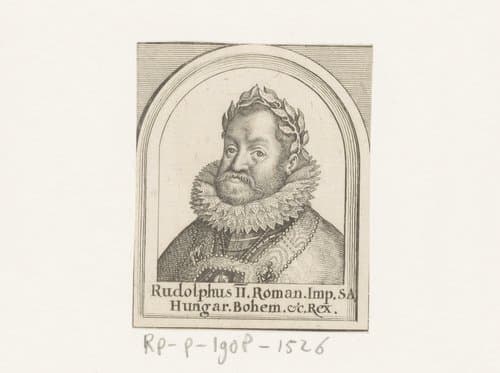
Portret van keizer Rudolf II
1603 - 1650
Medium
engraving
Dimensions
68; 58
Rights
Public Domain
About this artwork
blad: hoogte 68 mm x breedte 58 mm
Art Historical Context
Behold the intricate *Portret van keizer Rudolf*, a delicate engraving by the renowned Swiss artist Matthäus Merian the Elder (1593–1650). sometime between 1603 and1650, this diminutive portrait measures just 68 mm high by 58 mm wide, the likeness of Holy Roman Emperor Rudolf II (1552–1612) with remarkable precision. Merian, a master engraver and publisher celebrated for topographical views and detailed illustrations, exemplifies the technical virtuosity of early Baroque printmaking. Rudolf II ruled from Prague, transforming his court into a vibrant hub of Renaissance curiosity and Mannerist art. A passionate patron and collector, he amassed wonders from across Europe—paintings, scientific instruments, and exotic oddities—fostering artists like Giuseppe Arcimboldo. This engraving likely served as a portable emblem of imperial power, disseminating the emperor's image through books, atlases, or private collections during a time of religious strife and Habsburg ambition. Engraving's fine lines allowed Merian to convey Rudolf's regal poise and intellectual aura on such a tiny scale, highlighting the medium's role in democratizing elite portraiture. A testament to 17th-century craftsmanship, it invites us to ponder the emperor's enigmatic legacy as both ruler and dreamer.