
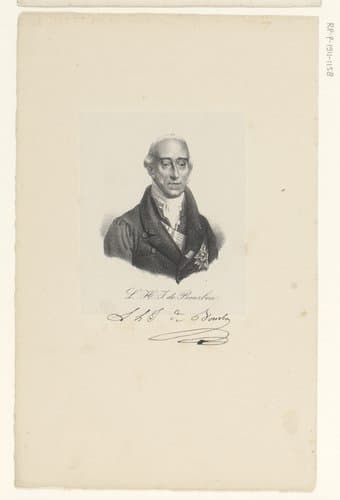
Portret van Lodewijk VI de Bourbon-Condé
in of na 1818 - in of voor 1842
Medium
lithography
Dimensions
277; 177
Rights
Public Domain
About this artwork
height 277 mm x width 177 mm
Art Historical Context
Step into the elegant world of 19th-century French nobility with *Portret van Lodewijk VI de-Condé*, a lithographic portrait capturing Louis VI, Prince of Condé (1756–1830). This Bourbon-Condé scion was a key figure in theist émigré circles during the French Revolution and Napoleonic Wars, embodying the resilience of the ancien régime. Produced anonymously by the workshop of veuve Delpech (Naudet)—a prominent Parisian lithographer—the print dates from sometime between 1818 and 1842, likely commemorating the prince's legacy amid the Bourbon Restoration. Lithography, the innovative medium here (277 mm × 177 mm), revolutionized portraiture in the early 19th century. Invented around 1798, it allowed artists to draw directly on stone with greasy crayon, enabling affordable, high-quality reproductions for a growing middle-class audience. This technique's subtle tonal gradations brought lifelike detail to Louis VI's dignified features, making aristocratic imagery accessible beyond elite circles. As a cultural artifact, the portrait reflects post-Revolutionary France's nostalgia for Bourbon grandeur, bridging royal tradition with modern print technology. It invites us to ponder how lithography democratized history, preserving the faces of the past for curious eyes today.