
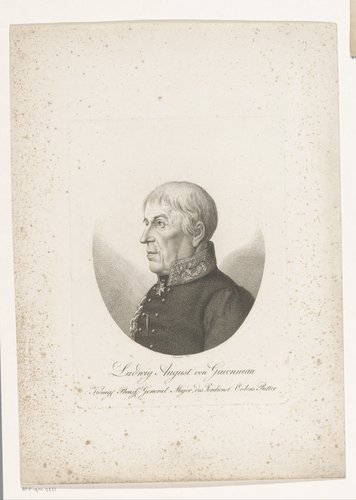
Portret van Ludwig August von Guionneau
1792 - 1829
Medium
etching
Dimensions
193; 144
Rights
Public Domain
About this artwork
collector's mark: Lugt 2228
Art Historical Context
Behold the delicate *Portret van Ludwig August von Guionneau*, an etching crafted by Ludwig Buchhorn between 1792 and 1829. This intimate portrait captures the likeness of its namesake subject, likely a figure of note from the late Enlightenment era, rendered in a compact format of 193mm by 144mm—perfect for personal collections or albums. Etching, a printmaking technique where acid bites into a metal plate to create fine lines, allowed artists like Buchhorn to produce detailed, reproducible images with remarkable precision and tonal depth, bridging painting's artistry with the accessibility of prints. In the context of early 19th-century Europe, such portraits reflected a growing fascination with individual identity amid social and political upheavals like the Napoleonic Wars. Buchhorn's work exemplifies the period's shift toward more naturalistic representations, emphasizing subtle textures in clothing and expression. The presence of the collector's mark Lugt 2228—cataloged by connoisseur Frits Lugt—hints at its esteemed provenance, linking it to a distinguished lineage of art enthusiasts who prized these finely executed engravings. This modest yet masterful piece invites us to ponder the personal stories etched into history, reminding visitors of printmaking's role in democratizing portraiture for a broader audience.
About the Artist
Ludwig Buchhorn · 1777–1856
Karl Ludwig Bernhard Christian Buchhorn (1770–1856) was a distinguished German painter and engraver whose career spanned the transformative period from the late Enlightenment through the Romantic era to the eve of German unification. Born on April 18, 1770, in Halberstadt—a historic city in what was then the Principality of Halberstadt within the Kingdom of Prussia—Buchhorn became one of Berlin's ...