
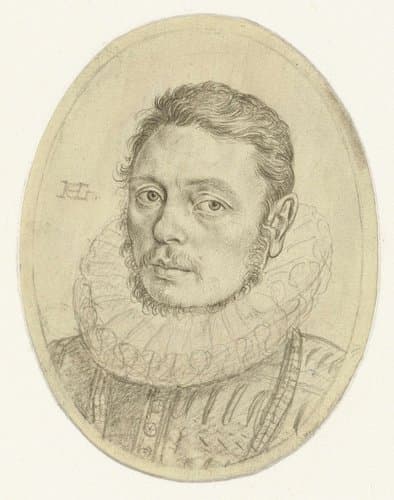
Portret van Pieter Dircksz. Hasselaer (?)
1578 - 1588
Medium
parchment (animal material)
Dimensions
44; 57
Rights
Public Domain
About this artwork
Dit portret is identiek aan dat van een op de achterkant door Goltzius in 1583 (B215) gegraveerde staande halberdier. Het opschrift op de gravure zinspeelt op de moedige verdedigers van Haarlem gedurende het beleg, één van hen was Hasselaer. Deze identificatie sluit niet de vergelijking uit met het geschilderde portret van W. van den Valckert, bekend van een kopie in het Rijksmuseum, cat. 1934, no. 2358. Pieter Dircksz Hasselaer (1544-1616) was vaandeldrager gedurende het beleg van Haarlem in 15...
Art Historical Context
This intimate miniature portrait on parchment, created by the renowned Dutch Mannerist artist Hendrick Goltus between 1578 1588, measures just 57mm by 44mm, showcasing the precision of his draftsmanship. Likely depicting Pieter Dircksz. Hasser (1544–1616), it mirrors an engraving Goltzius made in 1583 of a standingberdier (B215), whose inscription honors the courageous defenders of Haarlem during the brutal siege of 157273—a pivotal moment in the Dutch Revolt for independence. Hasselaer, a-bearer in that heroic defense, later rose to prominence as a magistrate in Amsterdam and one of the founders of the Dutch East India Company around 1594, linking this artwork to the dawn of Dutch global trade. Earlier scholars debated the sitter's identity, suggesting figures like Gerrit de Jongh or mathematician N. Blok, and noting similarities to a painted portrait by Willem van den Valckert. Goltzius's use of parchment—a rare, animal-derived medium—highlights innovative techniques for portable, detailed likenesses, blending portraiture with historical commemoration in the turbulent Eighty Years' War era.
About the Artist
Hendrick Goltzius · 1558–1617
Hendrick Goltzius (1558–1617) was the most celebrated engraver of the Northern Renaissance and a pivotal figure in Dutch Mannerism. Born near the German-Dutch border, Goltzius transformed printmaking into a virtuoso art form through his revolutionary 'swelling line' technique, where the burin was manipulated to create lines of varying thickness that produced unprecedented tonal effects and three-d...