
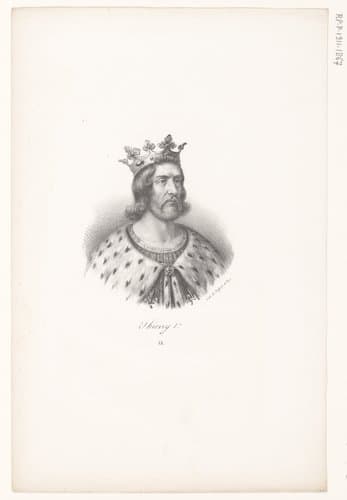
Portret van Theuderik I
in or after 1818 - in or before 1842
Medium
lithography
Dimensions
276; 181
Rights
Public Domain
About this artwork
lithografie
Art Historical Context
Behold the *Portret van Theuderik I*, a striking 19th-century lithograph capturing the visage of Theodoric I, the early Visigothic king who ruled from 418 to 451 AD. Produced by the widow Delpech (Naudet) with an anonymous artist, this work dates to between 1818 and 1842, measuring a modest 276 mm high by 181 mm wide. Rendered in the Dutch title, it reflects a European fascination with ancient rulers during the Romantic era, when historical figures were revived through print to inspire national and cultural pride. Theodoric I's legacy endures as a pivotal leader who allied with Romans against Attila the Hun at the Battle of the Catalaunian Plains in 451 AD, helping preserve Western Europe from invasion. This portrait, likely imagined from sparse historical records, immortalizes his stern profile in a neoclassical style, bridging antiquity and modernity for contemporary audiences eager to connect with barbarian-era heroes. Lithography, the medium here, revolutionized art printing in the early 1800s. Invented by Alois Senefelder, it used greasy crayons on limestone to produce nuanced tones and fine details affordably—ideal for disseminating portraits like this. As one of lithography's early triumphs, it democratized access to history, turning elite museum subjects into everyday inspirations.