
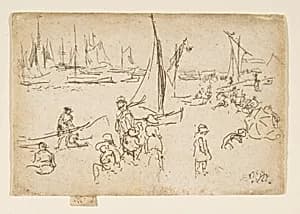
Portsmouth Children (Children, Portsmouth)
Medium
Etching, printed in black ink on ivory laid paper; only state (Glasgow)
Dimensions
Plate: 2 5/8 × 3 7/8 in. (6.6 × 9.9 cm) Sheet: 2 5/8 × 3 7/8 in. (6.6 × 9.9 cm)
Classification
Prints
Department
Drawings and Prints
Museum
Metropolitan Museum of Art, New York, NY
Credit
Harris Brisbane Dick Fund, 1917
Accession Number
17.3.143
Rights
Public Domain
Tags
Art Historical Context
James McNeill Whistler’s 1887 etching *Portsmouth Children* captures a fleeting moment of everyday life along the English coast. Created during a period when the American-born artist was deeply engaged with printmaking in Britain, the small plate—measuring just over 2 by 3 inches—depicts children near boats in Portsmouth harbor. Its intimate scale invites close looking, revealing Whistler’s mastery of line and economy of detail. As an etching printed in a single state, the work demonstrates the artist’s preference for direct, un-revised impressions that preserve the freshness of the drawn line. Whistler, celebrated for elevating etching from reproductive craft to fine art, often found inspiration in harbor scenes and the quiet presence of figures within them. The spare composition reflects his interest in suggestion over elaboration, allowing viewers to sense the gentle rhythms of coastal activity. Acquired by the Metropolitan Museum through the Harris Brisbane Dick Fund in 1917, this delicate print exemplifies Whistler’s enduring contribution to American and British graphic arts. Its modest size and focused subject reward patient observation, offering a window into both the artist’s technical skill and the simple pleasures of a late-nineteenth-century port town.
About the Artist
James McNeill Whistler · 1834–1903
James Abbott McNeill Whistler (1834-1903) was an American-born painter and printmaker who became a leading figure in the Aesthetic Movement and pioneer of Tonalism and Japonisme. He revolutionized art by championing "art for art's sake" and treating paintings as visual equivalents of musical compositions, titling works as "arrangements," "harmonies," and "nocturnes" to emphasize formal qualities o...