
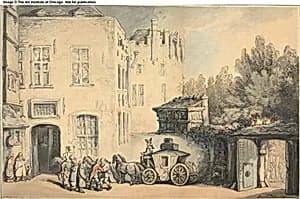
Post House in Cologne
Medium
Pen and gray and brown ink with brush and watercolor, over traces of graphite, on tan wove paper, laid down on card
Dimensions
28 × 43.2 cm (11 1/16 × 17 1/16 in.)
Classification
watercolor
Department
Prints and Drawings
Museum
Art Institute of Chicago
Accession Number
21777
Rights
Public Domain
Art Historical Context
Thomas Rowlandson’s *Post House in Cologne* (1) captures a bustling scene from the artist’s travels along the Rhine River in Germany. This lively watercolor depicts the historic post house—a key stop for horse-drawn coaches and travelers—in the medieval city of Cologne, offering a vivid snapshot of 18th-century European life. Rowlandson, a renowned English caricaturist and watercolorist active during the late Georgian era, was celebrated for his humorous, fluid depictions of everyday scenes, blending satire with topographical precision. Created during a period of political upheaval leading into the French Revolutionary Wars, the work reflects the era’s Grand Tour culture, where British artists like Rowlandson sketched picturesque continental landmarks. Cologne, with its towering Gothic cathedral and thriving trade along the Rhine, symbolized cultural exchange and commerce. Rowlandson’s piece preserves this transient world, highlighting the post house’s role in facilitating travel and communication across Europe. Executed in pen and gray and brown ink with brush and watercolor over graphite traces on tan wove paper (28 × 43.2 cm), the medium allowed for spontaneous yet detailed rendering—loose, expressive lines evoking movement and atmosphere. Housed in the Art Institute of Chicago’s Prints and Drawings department, this classified watercolor exemplifies Rowlandson’s mastery in transforming quick sketches into enduring, colorful narratives of history.
About the Artist
Thomas Rowlandson · 1756–1827
Thomas Rowlandson (1757–1827) was an English artist and caricaturist whose satirical watercolors and prints captured the social life of Georgian Britain with unparalleled wit and technical mastery. Alongside James Gillray, he is recognized as one of the greatest British graphic artists, and his distinctive flowing line and keen observations have made his work integral to understanding late 18th an...