
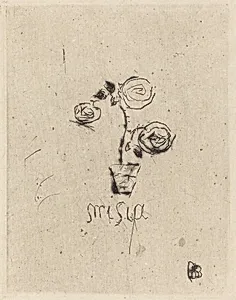
Preliminary design of book-plate for Misia
c.1920
Medium
etching
Dimensions
plate: 7.2 x 5.7 cm (2 13/16 x 2 1/4 in.) sheet: 7.5 x 12.5 cm (2 15/16 x 4 15/16 in.)
Classification
Department
CG-E
Museum
National Gallery of Art, Washington, D.C.
Credit
Virginia and Ira Jackson Collection
Accession Number
2005.157.4
Rights
Public Domain
Art Historical Context
Pierre Bonnard's *Preliminary design of book-plate for Mis* (c. 1920) is a charming etching from the National Gallery of Art's Virginia and Ira Jackson Collection. just 7.2 x 5.7 cm on the plate, this intimate print served as a preparatory sketch for an ex-libr—a personalized bookplate used to mark ownership in private libraries. Created during Bonnard's mature period, it reflects the French artist's affinity for everyday elegance amid the cultural vibrancy of early 20th-century Paris. As a master of Post-Impressionism and a key figure in the Nabi movement, Bonnard infused his prints with the same decorative patterns and luminous warmth seen in his paintings. Etching, an intaglio technique where acid bites into a metal plate to create fine, expressive lines, allowed Bonnard to achieve delicate textures and subtle tonal variations perfectly suited to this diminutive scale. The medium's precision highlights his skill in translating painterly intimacy into graphic form. This work underscores the era's fascination with bespoke artistry among intellectuals and patrons like Misia, evoking a world where books were treasures adorned with personal flair. A testament to Bonnard's versatility, it invites visitors to appreciate the quiet poetry of functional design.
About the Artist
Pierre Bonnard · 1867–1947
Pierre Bonnard (1867–1947) was a French painter and printmaker who became a leading figure in the Post-Impressionist movement and a founding member of Les Nabis. Born on October 3, 1867, in Fontenay-aux-Roses, France, Bonnard initially studied law at his father's insistence, graduating and briefly practicing as a barrister in 1888. However, his true passion lay in art, and he had simultaneously at...