
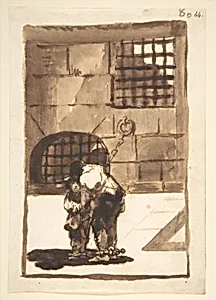
Prisoners in irons; page 80 from the 'Images of Spain' album (F)
ca. 1812–20
Medium
Brush, brown ink washes, over touche of black chalk on laid paper
Dimensions
Sheet: 8 1/8 × 5 5/8 in. (20.7 × 14.3 cm)
Classification
Drawings
Department
Drawings and Prints
Museum
Metropolitan Museum of Art, New York, NY
Credit
Harris Brisbane Dick Fund, 1935
Accession Number
35.103.44
Rights
Public Domain
Tags
Art Historical Context
Behold *Prisoners in Irons page 80 from Francisco de Goya y Lucientes's *Images of Spain* albumF), a poignant drawing crafted around 1812–20. This intimate work on laid paper, measuring just 8⅛ × 5⅝ inches, employs brush-applied brown ink washes over subtle touches of black chalk. Goya, a master of Spanish Romanticism, produced these private albums during a turbulent era, channeling his disillusionment into raw, unflinching visions of human suffering. Created amid Spain's Peninsular War and the repressive reign of Ferdinand VII, the album captures the horrors of conflict and tyranny. Prisoners shackled in irons evoke the brutal realities of imprisonment and oppression that scarred Goya's homeland, reflecting his shift toward darker, more introspective themes in his later years. These works, unseen by the public in his lifetime, prefigure modern expressions of psychological torment. Goya's masterful washes build dramatic shadows and textures, heightening the emotional intensity and sense of confinement. This technique, blending precision with fluidity, underscores his innovative draftsmanship and enduring influence on later artists exploring war's dehumanizing toll. Now in the Metropolitan Museum of Art's Drawings and Prints collection (Harris Brisbane Dick Fund, 1935), it invites visitors to confront the timeless cost of cruelty.
About the Artist
Goya (Francisco de Goya y Lucientes) · 1746–1828
Francisco José de Goya y Lucientes (1746-1828) was a Spanish painter and printmaker considered the last of the Old Masters and the first of the moderns. Rising from modest provincial origins to become First Court Painter to Charles IV, Goya's career spanned the Enlightenment's optimism and the brutal Napoleonic invasion that shattered it. A mysterious illness in 1793 left him permanently deaf and ...