
Project for a Chapel in the Church of San Ciriaco, Ancona
1700–1773
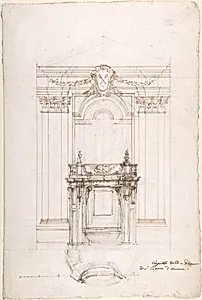
Medium
Pen and dark brown ink, over freehand graphite and ruled construction lines in graphite
Dimensions
17 x 11-5/16 in. (43.2 x 28.7 cm)
Classification
Drawings
Department
Drawings and Prints
Museum
Metropolitan Museum of Art, New York, NY
Credit
The Elisha Whittelsey Collection, The Elisha Whittelsey Fund, 1968
Accession Number
68.725.1
Rights
Public Domain
Tags
Art Historical Context
Step into the intricate world of 18th Italian architecture with Luigi Vanvitelli *Project for a Chapel in Church of San Ciriac, Ancona*. This drawing, created between 1700 and 1773, captures Vanvit's visionary design for enhancing the historic cathedral in Ancona, a bustling Adriatic port city. As one of Italy's leading architects, Vanvitelli the opulent Baroque style with emerging Neoclassicism, evident in his grand projects like the Royal Palace of Caserta. This chapel proposal reflects his skill in ecclesiastical design, blending functionality with dramatic spatial effects to inspire devotion. Rendered in pen and dark brown ink over freehand graphite sketches and ruled construction lines, the 17 x 11-5/16-inch sheet (43.2 x 28.7 cm) reveals the meticulous planning process of the era. Graphite lines provide the foundational geometry, while the fluid ink adds precise details—vaults, altars, and ornamental motifs—showcasing how architects visualized complex structures on paper before construction. Such drawings were essential tools for patronage negotiations and on-site execution. Housed in the Metropolitan Museum of Art's Drawings and Prints department, thanks to The Elisha Whittelsey Collection, this work offers a rare glimpse into Vanvitelli's creative mind. It highlights the cultural role of chapels as personal memorials or family commissions, underscoring architecture's power to elevate sacred spaces in Renaissance and Baroque Italy.
About the Artist
Luigi Vanvitelli · 1700–1773
Born 12 May 1700; died 1 March 1773. Famous for his design for the Royal Palace at Caserta, built 1751. Vanvitelli was active in Rome, Naples and nearby towns, also Brescia, Milan and Genoa. Comment on works: Portraits