
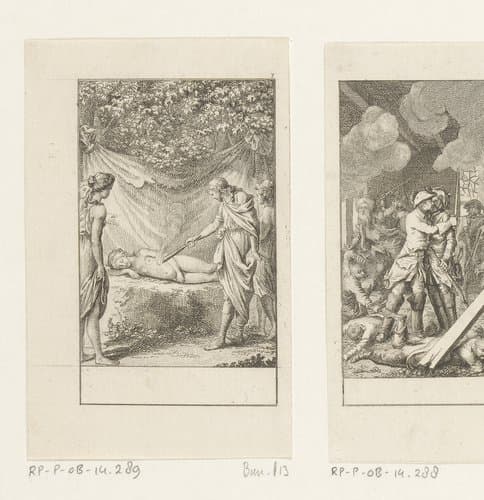
Prometheus wekt Pandora tot leven
Medium
etching
Dimensions
67; 106
Rights
Public Domain
About this artwork
height 106 mm x width 67 mm
Art Historical Context
Daniel Nikolaus Chodowiecki's etching *Prometheus wekt Pandora tot leven* (Prometheus Awakens Pandora to Life), created in 1781, a pivotal moment from Greek mythology. In the myth, Prometheus, the Titan who stole fire for humanity, molds the first woman, Pandora, from clay and breathes life into her as a gift—and curse—from the gods. This small-scale work (106 mm x 67 mm) exemplifies Chodowiecki's mastery of intimate, narrative-driven scenes, blending Rococo elegance with Enlightenment fascination for classical antiquity. As a leading German graphic artist and director of the Berlin Academy of Arts, Chodowiecki was renowned for his prolific output of over 2,000 etchings, often illustrating literature and moral tales. Etching allowed him to achieve fine lines and subtle tonal gradations, conveying emotion and drama in miniature format—ideal for book illustrations or collector's prints. Here, the technique highlights the tender yet ominous animation of Pandora, foreshadowing her role in unleashing evils upon the world. This piece reflects 18th-century Europe's revival of mythological themes amid neoclassical trends, inviting viewers to ponder humanity's origins and flaws. Chodowiecki's accessible style made such profound stories relatable, bridging ancient lore with modern audiences in an era of intellectual curiosity.
About the Artist
Daniel Nikolaus Chodowiecki · 1726–1801
Daniel Nikolaus Chodowiecki (1726–1801) was a German painter and printmaker of Polish-Huguenot descent who became the most celebrated graphic artist in 18th-century Germany. Born in Danzig (now Gdańsk), he created approximately 2,000 etchings that serve as an invaluable visual record of German bourgeois life during the Enlightenment. Largely self-taught, Chodowiecki moved to Berlin in 1743 and ach...