
Prosper Jolyot de Crebillon
1726 to 1750
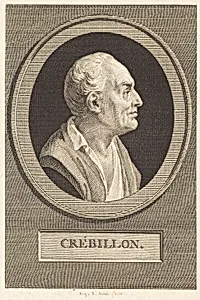
Medium
engraving over etching on laid paper
Dimensions
sheet (trimmed within plate mark): 20.1 x 12 cm (7 15/16 x 4 3/4 in.)
Classification
Department
CG-E
Museum
National Gallery of Art, Washington, D.C.
Credit
Gift of John O'Brien
Accession Number
1986.88.26
Rights
Public Domain
Art Historical Context
This delicate engraving, *Prosper Jolyot de Crébillon*, captures the likeness of the renowned French playwright (1674–1762), a master of classical tragedy whose works like *Rhadamiste et Zénobie* rivaled those of Voltaire in 18th-century Paris. Created by Augustin de Saint-Aubin 1726 and 1750, it exemplifies the Rococo era's elegance, where portrait prints immortalized intellectuals and literati amid the cultural vibrancy of Louis XV's court. Saint-Aubin, a prolific engraver from a family of artists, employed a sophisticated technique: etching for fluid outlines and engraving for intricate details, layered on laid paper—a period staple prized for its texture and durability. At just 20.1 x 12 cm, this intimate sheet (trimmed within the plate mark) was likely produced as a collectible for admirers, reflecting the booming market for affordable reproductive prints that democratized access to celebrity portraits. Housed in the National Gallery of Art's Prints department (CG-E) through the generous gift of John O'Brien, this work highlights the artistry of printmaking as a bridge between painting and popular culture, preserving Crébillon's stern gaze for modern visitors.
About the Artist
Augustin de Saint-Aubin · 1736–1807
Comment on works: Illustrator; Engraver