
Ptah
Unknown Artist
late 8th–mid 7th century B.C.
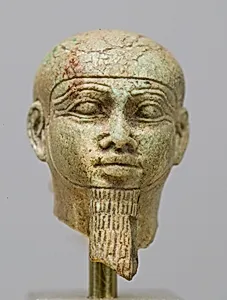
Medium
Limestone
Dimensions
H. 1.6 cm (5/8 in.)
Classification
Head, Ptah
Period
Third Intermediate Period
Department
Egyptian Art
Museum
Metropolitan Museum of Art, New York, NY
Credit
Gift of Helen Miller Gould, 1910
Accession Number
10.130.2600
Rights
Public Domain
Tags
Art Historical Context
This petite limestone head, titled *Ptah* and dating to the late 8th–mid 7th century B.C., captures the essence of one of ancient Egypt's most revered deities during the Third Intermediate Period's Dynasty 25, the Kushite era. Standing just 1.6 cm tall, it likely served as an amulet or votive offering, reflecting the Nubian rulers' deep reverence for traditional Egyptian gods. The Kushites, originating from modern-day Sudan, briefly unified Egypt and sparked a renaissance in art and religion, blending their own influences with pharaonic customs. Ptah, the creator god and patron of artisans from Memphis, is typically shown with a close-fitting skullcap and a serene, enigmatic expression symbolizing eternal wisdom and craftsmanship. Carved from limestone—a durable, locally sourced stone ideal for small-scale works—this piece exemplifies the period's refined sculptural techniques, with smooth contours and incised details that convey divine authority despite its miniature size. Such objects were worn for protection or placed in shrines, underscoring everyday devotion in a time of political flux. Today, this rare artifact graces the Egyptian Art collection at the Metropolitan Museum of Art, a gift of Helen Miller Gould in 1910, offering visitors a tangible link to Kushite spirituality and the enduring power of Egypt's pantheon.