
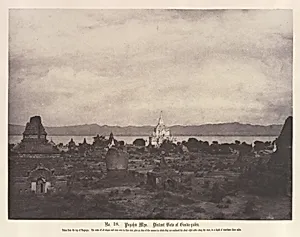
Pugahm Myo: Distant View of Gauda-palen Pagoda
August 20–24, 1855
Medium
Albumen silver print from waxed(?) paper negative
Dimensions
Image: 25.3 x 34.1 cm (9 15/16 x 13 7/16 in.) Mount: 45.6 x 58.3 cm (17 15/16 x 22 15/16 in.) Mat: 20 × 24 in. (50.8 × 61 cm)
Classification
Photographs
Department
Photographs
Museum
Metropolitan Museum of Art, New York, NY
Credit
Purchase, The Buddy Taub Foundation, Dennis A. Roach and Jill Roach, Directors, and Alfred Stieglitz Society Gifts, 2012
Accession Number
2012.323.8
Rights
Public Domain
Tags
Art Historical Context
Linnaeus Tripe’sPugahm Myo: Distant View of Gauda-palen Pagoda” offers a serene glimpse of Burma’s ancient landscape in 1855. Created during Tripe’s official expedition as a British army officer and pioneering photographer, the image captures the monumental Gauda-palen Pagoda amid rolling terrain and distant mountains. At a time when few Western viewers had seen these sites, Tripe’s work helped document the architectural splendor and ruins of Bagan for both scholarly and public audiences. The photograph is an albumen silver print made from a waxed paper negative, a technique that allowed for rich tonal detail and portability in the field. This medium was still relatively new in the mid-1850s, and Tripe’s use of it demonstrates early photography’s power to record vast architectural complexes with both precision and atmospheric depth. The resulting print balances the grandeur of the pagoda against the surrounding landscape, inviting viewers to appreciate the harmony between human-made structures and nature. Today housed in the Metropolitan Museum of Art, the work stands as an important record of 19th-century exploration and the beginnings of photographic documentation in Southeast Asia. Its quiet, expansive view continues to fascinate visitors interested in the intersection of history, architecture, and the evolving art of photography.
About the Artist
Linnaeus Tripe · 1822–1902
Linnaeus Tripe (1822–1902), born in Devonport, England, as the ninth of twelve children to Mary and Cornelius Tripe, pursued a military career influenced by his sister Emily's marriage to an army colonel. Joining the East India Company's Madras Infantry as a cadet in 1838, he rose to lieutenant in southern India by 1840 and captain in Bangalore by 1854. Extended leave in England from 1850 due to i...