
Punch bowl (jatte à punch)
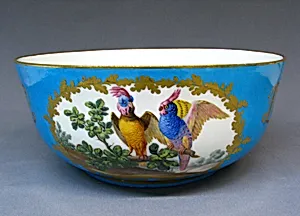
Medium
Soft-paste porcelain
Dimensions
5 1/8 × 13 1/4 in. (13 × 33.7 cm)
Classification
Ceramics-Porcelain
Culture
French, Sèvres
Department
European Sculpture and Decorative Arts
Museum
Metropolitan Museum of Art, New York, NY
Credit
Rogers Fund, 1971
Accession Number
1971.274
Rights
Public Domain
Tags
Art Historical Context
This elegant punch bowl, known as a *jatte à punch hails from the renowned Sèvres Manuf in France, crafted in 1772 and painted by Etienne Evans. Made of soft-paste porcelain—a, translucent material prized for its creamy white body and ability to showcase intricate overglaze enamels—this piece measures a compact 5⅛ × 13¼ inches, perfect for serving punch at aristocratic gatherings during the late Louis XV era. Adorned with finely painted motifs of birds and acorns, the bowl exemplifies Sèvres' mastery of naturalistic decoration, a hallmark of French porcelain artistry. Soft-paste allowed artists like Evans to apply vibrant colors and detailed gilding that fired brilliantly, capturing the playful abundance of rococo-inspired nature themes. These motifs evoked the pastoral idylls of 18th-century French gardens, blending utility with opulence. As a product of the royal Sèvres factory, patronized by the crown, this bowl reflects the height of European decorative arts, symbolizing luxury and refinement. Acquired through the Rogers Fund in 1971, it now graces the Metropolitan Museum of Art's European Sculpture and Decorative Arts collection, inviting visitors to savor a slice of Versailles-era elegance.
About the Artist
Sèvres Manufactory|Etienne Evans · 1740–present
The Sèvres Manufactory, one of Europe's premier porcelain producers, was established in 1740 as the Manufacture de Vincennes under the patronage of Queen Marie Leszczyńska, who sought to rival Meissen and Chantilly porcelains with French soft-paste innovations. Initially a private venture, it relocated to Sèvres in 1756 in a purpose-built facility designed by architect Laurent Lindet near Madame d...