
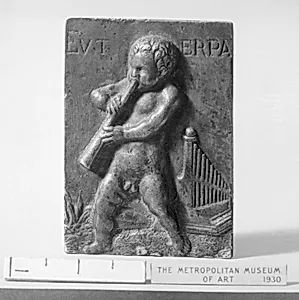
Putto with attributes of the Muse Euterpe
16th century
Medium
Silver gilt
Dimensions
1 7/8 × 1 1/4 in. (4.8 × 3.2 cm)
Classification
Medals and Plaquettes
Culture
German, Nuremberg
Department
European Sculpture and Decorative Arts
Museum
Metropolitan Museum of Art, New York, NY
Credit
Theodore M. Davis Collection, Bequest of Theodore M. Davis, 1915
Accession Number
30.95.130
Rights
Public Domain
Tags
Art Historical Context
In the bustling Renaissance workshops of 16th-century Nuremberg, Germany, artist Peter Flötner crafted this exquisite silver gilt plaquette, *Putto with Attributes of the Muse Euterpe*. Measuring just 1 7/8 × 1 1/4 inches, this tiny relief sculpture captures a playful putto—a chubby, winged child figure beloved in Renaissance art—holding symbols of Euterpe, the ancient Greek Muse of music and lyric poetry, such as a flute or lyre. Flötner's design blends classical mythology with Northern European charm, showcasing his mastery of intricate low-relief carving on the precious metal, which was then gilded for a luminous glow. Nuremberg was a thriving center for goldsmiths and engravers during the Renaissance, and plaquettes like this one were prized collectibles, akin to Renaissance trading cards. They allowed patrons to display humanist ideals—reviving antiquity's muses amid the era's artistic revival—on cabinets or jewelry. Flötner's style, influenced by Italian models yet distinctly German in its robust forms, exemplifies this cultural exchange. Today, this delicate piece from the Theodore M. Davis Collection graces the Metropolitan Museum of Art's European Sculpture and Decorative Arts department. It invites us to ponder music's timeless joy, embodied in the putto's mischievous gaze, bridging ancient inspiration with Renaissance ingenuity.
About the Artist
Peter Flötner · 1485–1546
Peter Flötner (c. 1485–1546) was a German sculptor, ornament designer, and medalist whose work played a central role in the transmission of Italian Renaissance decorative vocabulary into the German-speaking lands. Though his exact origins remain uncertain — he may have trained in Augsburg before settling permanently in Nuremberg around 1522 — his formation evidently included exposure to Italian Re...