
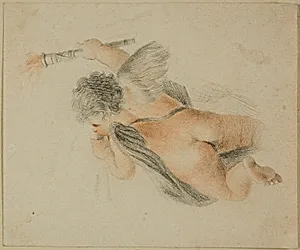
Putto with Torch
Medium
Red and black chalk on cream wove paper, tipped onto cream wove paper
Dimensions
12.5 × 10.5 cm (4 15/16 × 4 3/16 in.)
Classification
chalk
Department
Prints and Drawings
Museum
Art Institute of Chicago
Accession Number
115775
Rights
Public Domain
Art Historical Context
Giovanni Battista Cipriani’s *Putto with Torch* captures the playful yet graceful spirit of classical mythology through a delicate chalk study. A putto—a chubby, often winged child figure drawn from ancient Roman and Renaissance traditions—appears here holding a flaming torch, evoking themes of enlightenment, love, or divine inspiration. Cipriani, an eighteenth-century Italian artist who spent much of his career in England, frequently explored such motifs in decorative schemes and book illustrations, blending Baroque exuberance with emerging Neoclassical restraint. The drawing’s intimate scale—just 12.5 by 10.5 centimeters—suggests it may have served as a preparatory sketch. Cipriani employs red and black chalk on cream wove paper to model the figure’s soft contours and gentle shadows, a technique prized for its warm, lifelike quality. The red chalk lends a lifelike glow to the child’s skin while black chalk defines crisp outlines and deeper folds, demonstrating the artist’s mastery of tonal contrast on a modest surface. Housed in the Art Institute of Chicago’s Prints and Drawings department, this work offers visitors a glimpse into Cipriani’s process and the enduring appeal of classical imagery in eighteenth-century European art.
About the Artist
Giovanni Battista Cipriani · 1766–1839
Giovanni Battista Cipriani was born on April 20, 1766, in Siena, Italy, to Simon Pietro Cipriani and Eva Bandini. He grew up alongside his brothers Barbato, a sculptor, and Galgano, an engraver, in a family immersed in the arts. Cipriani began his education studying Latin and mathematics before pursuing fine arts under the sculptor and architect Giuseppe Silini in Siena.) His talent earned him a p...