
Quadrans (Coin) Depicting the Hero Hercules
225-217 BCE
Medium
Bronze
Dimensions
Diam.: 4.5 cm (1 13/16 in.)
Classification
coin
Department
Arts of Greece, Rome, and Byzantium
Museum
Art Institute of Chicago
Accession Number
9888
Rights
Public Domain
About this artwork
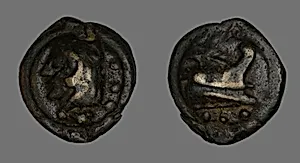
The front (obverse) of this coin depicts the hero Hercules, wearing his signature lion skin cloak. On the back (reverse), the prow of a ship is shown, sailing right. Herakles was the consummate hero. Temples across Greece and South Italy were dedicated to him, the son of Zeus, and Romans, who knew him as Hercules, celebrated him as a role model. With brute force, determination, and just enough cleverness, Herakles completed his famous Twelve Labors to become immortal. Herakles is readily identi...
Art Historical Context
This diminutive bronze quadrans, struck by Ancient Romans between 225 and 217 BCE, showcases the hero Hercules on one side, capturing his iconic attributes like the club and lion's skin. Measuring just 4.5 cm in diameter, it was the smallest denomination in early Roman coinage—worth a quarter of the as—used for everyday transactions in the bustling markets of the Roman Republic. As part of the Art Institute of Chicago's Arts Greece, Rome, andantium collection, it exemplifies the shift from cast bronze bars to hammered, struck coins, a technological leap that allowed for intricate designs on miniature scales. Minted during the tense years leading into the Second Punic War against Carthage, this coin reflects Rome's growing imperial ambitions and cultural reverence for Hercules. Adopted from Greek mythology as Heracles, he embodied superhuman strength, protection, and triumph—qualities Romans invoked for military prowess and civic pride. The reverse likely features a prow or other Republican motifs, common on these "litra" coins, blending propaganda with portraiture in a medium that doubled as portable art. Artistically, the quadrans highlights Roman mastery of die-stamping on bronze, producing durable, mass-reproducible images that circulated Hercules' legend far and wide. A tiny testament to ancient ingenuity, it invites us to ponder how even pocket change shaped cultural identity in antiquity.
About the Artist
Ancient Roman
The artists attributed to "Ancient Roman" in museum collections represent the anonymous craftsmen who produced the vast output of sculpture, frescoes, mosaics, and reliefs defining Roman visual culture from the Republic (c. 509–27 BCE) to the late Empire (c. 395 CE). Individual identities remain elusive, as Roman makers were typically viewed as skilled tradesmen—often enslaved Greeks or provincial...