
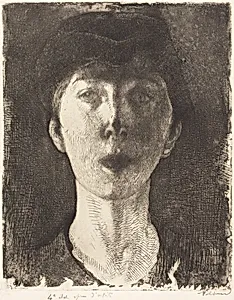
Queen Elisabeth of Belgium (La Reine Élisabeth de Belgique)
1917
Medium
etching, dypoint, and printed tone on Arches laid paper
Dimensions
plate: 30.9 x 24.6 cm (12 3/16 x 9 11/16 in.) sheet: 33.6 x 26.1 cm (13 1/4 x 10 1/4 in.)
Classification
Department
CG-E
Museum
National Gallery of Art, Washington, D.C.
Credit
Gift of Mr. and Mrs. Daniel Bell, in Honor of the 50th Anniversary of the National Gallery of Art
Accession Number
1991.28.10
Rights
Public Domain
Art Historical Context
Albert Besnard's *Queen Elisabeth of Belgium (La Reine Élisabeth Belgique)*, created in 1917, the poised elegance of Belgium's beloved queen amid the turmoil of World War I. a master French printmaker associated with Symbolism and later academic portraiture, Besnard immortalized Elisabeth, who earned international admiration for her compassionate work nursing wounded soldiers on the Western Front. This intimate etching reflects the era's heightened patriotism and humanitarian spirit, with the bilingual title underscoring her multilingual grace and cross-cultural appeal. Executed in etching, drypoint, and printed tone on fine Arches laid paper (plate: 30.9 x 24.6 cm), the work showcases Besnard's virtuosic command of intaglio techniques. Etching provides precise lines, drypoint adds rich, burr-like texture for depth and softness, and printed tone—likely aquatint effects—evokes a painterly luminosity, blending precision with atmospheric subtlety. These methods allowed Besnard to convey both regal dignity and emotional warmth in a modest format. Now housed in the National Gallery of Art's print collection (gift of Mr. and Mrs. Daniel Bell honoring the museum's 50th anniversary), this piece highlights the power of portrait prints to preserve historical figures. Visitors will appreciate its technical finesse and poignant reminder of wartime resilience.
About the Artist
Albert Besnard · 1849–1934
Paul-Albert Besnard, known as Albert Besnard, was born on June 2, 1849, in Paris to an artistic family: his father, Louis Adolphe Ferdinand Besnard, was a history painter and pupil of Ingres, while his mother, Marie Louise Pauline Vaillant, was a noted miniaturist trained under Lizinska de Mirbel. Precociously talented, he began his training under Jean-François Brémond before entering the École de...