
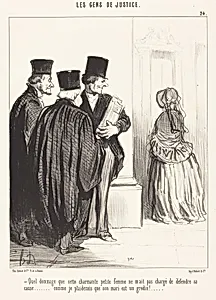
Quel dommage que cette charmante... femme...
1846
Medium
lithograph
Classification
Department
CG-E
Museum
National Gallery of Art, Washington, D.C.
Credit
Rosenwald Collection
Accession Number
1953.6.40
Rights
Public Domain
Art Historical Context
Honoré Daumier's *Quel dommage que cette charmante femme...* (1846) is a quintessential lithograph from the height of his prolific career as a satirical printmaker. Created during France's July Monarchy under King Louis-Philippe, Daumier produced thousands of such images for periodicals like *Le Charivari*, skewering the bourgeoisie, lawyers, and social hypocrisies. The—"What a pity that charming... woman..."—rips with irony, likely poking fun at courtroom dramas or gender expectations, a recurring theme in his incisive caricatures that captured the era's tensions leading toward the 1848 Revolution. Lithography, Daumier's favored medium, revolutionized printmaking by allowing artists to draw directly on stone for rich tonal effects and mass reproduction, making sharp social commentary accessible to the public. Here, his signature style shines: exaggerated expressions, dynamic compositions, and empathetic yet biting portrayals of human folly. This print exemplifies how Daumier blended artistry with activism, often landing him in legal trouble for his boldness. Housed in the National Gallery of Art's Rosenwald Collection, this work invites visitors to chuckle at 19th-century absurdities while reflecting on timeless truths about society and justice. A must-see for fans of political satire!
About the Artist
Honoré Daumier · 1810–1879
Honoré-Victorin Daumier (1808-1879) was a prolific French printmaker, caricaturist, painter, and sculptor whose works offered incisive commentary on the social and political life of 19th-century France. Known as the 'Michelangelo of Caricature,' Daumier produced over 4,000 lithographs, 500 paintings, 1,000 drawings, and 100 sculptures during his lifetime. His biting political satire led to his imp...