
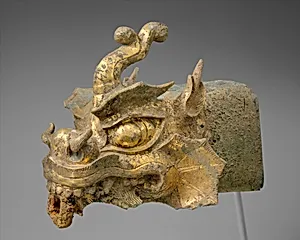
금동 용머리 모양 처마 끝 장식과 작은 종 고려|金銅龍頭吐首風鐸 高麗|Rafter finial in the shape of a dragon’s head and wind chime
Unknown Artist
10th century
Medium
Gilt bronze
Dimensions
Finial: 11 3/4 in. × 9 in. × 15 1/2 in. (29.8 × 22.9 × 39.4 cm) Chime: 15 1/4 × 7 1/4 in. (38.7 × 18.4 cm)
Classification
Sculpture
Culture & Period
Korea · early Goryeo dynasty (918–1392)
Department
Asian Art
Museum
Metropolitan Museum of Art, New York, NY
Credit
Purchase, The Vincent Astor Foundation Gift, 1999 Benefit Fund, and The Rosenkranz Foundation Inc. Gift, 1999
Accession Number
1999.263a, b
Rights
Public Domain
Tags
Art Historical Context
This exquisite gilt bronze rafter finial, crafted in the shape of a dragon’s head Korea’s early Goryeo dynasty (10th century), once adorned the eaves of a grand building, likely a Buddhist temple. Measuring nearly 16 inches long, the dynamic dragon—mouth agape—holds a delicate wind chime that would have tinkled softly in the breeze, warding off evil spirits and announcing the presence of divine protection. Dragons held profound symbolic power in Korean culture, imperial authority, rain-making prowess, and guardianship against misfortune. The piece exemplifies Goryeo artistry in its masterful lost-wax casting technique, where molten bronze was gilded for a luminous golden sheen that caught the sunlight. Such finials were essential architectural elements on curved roofs, blending functionality with spiritual symbolism during a golden age of Buddhism under the Goryeo rulers (918–1392). Acquired by The Metropolitan Museum of Art in 1999, it offers a rare glimpse into the dynasty’s sophisticated metalwork and reverence for mythical guardians. Today, this artifact whispers of ancient rituals, inviting visitors to imagine the chime’s haunting melody echoing through temple courtyards.