
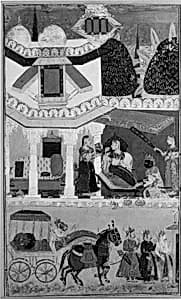
Ramkali Ragini: Folio from a ragamala series (Garland of Musical Modes)
Unknown Artist
ca.1680
Medium
Ink and opaque watercolor on paper
Dimensions
14 9/16 x 8 3/4 in. (37 x 22.2 cm)
Classification
Paintings
Culture
India (Rajasthan, Mewar)
Department
Asian Art
Museum
Metropolitan Museum of Art, New York, NY
Credit
Roger Fund, 1954
Accession Number
54.174
Rights
Public Domain
Tags
Art Historical Context
This exquisite folio, *Ramkali Ragini* from a Ragamala series ("Garland of Musical Modes hails from the Mewar region of Rajasthan, India, around 1680. Ragamala paintings are a poetic fusion of music, poetry, and visual art, where each *ragini* (a melodic mode derived from a *raga*) is personified evocative scenes, often drawing from Hindu mythology and romance. Created by an unknown artist in the vibrant Mewar school of miniature painting, this work uses ink and opaque watercolor on paper to capture intricate details in a compact 14 9/16 x 8 3/4 in. format. The composition likely evokes the melancholic essence of Ramkali Ragini, a winter mode associated with longing and devotion, featuring women, horses, chariots, and divine figures like Krishna and Radha. These elements symbolize spiritual love (*bhakti*) in Hinduism, with Radha's yearning for Krishna mirroring the raga's emotional pull. The opaque watercolors—layered for jewel-like intensity—highlight the Mewar style's bold lines, flattened perspectives, and luminous hues, hallmarks of Rajput painting that blended courtly patronage with devotional themes. As a single leaf from a larger series, it reflects 17th-century India's rich synesthetic culture, where music inspired visuals to guide performers and evoke moods. Now at the Metropolitan Museum of Art (Roger Fund, 1954), it invites us to "hear" the raga through its timeless imagery.