
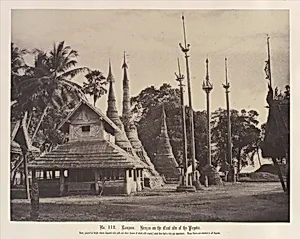
Rangoon: Henzas on the East Side of the Shwe Dagon Pagoda
November 1855
Medium
Albumen silver print from waxed paper negative
Dimensions
Image: 26.1 x 34.3 cm (10 1/4 x 13 1/2 in.) Mount: 45.7 x 58.4 cm (18 x 23 in.) Mat: 20 × 24 in. (50.8 × 61 cm)
Classification
Photographs
Department
Photographs
Museum
Metropolitan Museum of Art, New York, NY
Credit
Purchase, The Buddy Taub Foundation, Dennis A. Roach and Jill Roach, Directors, and Alfred Stieglitz Society Gifts, 2012
Accession Number
2012.323.30
Rights
Public Domain
Tags
Art Historical Context
Captured in November 1855, *Rangoon: Henzas on the East Side the Shwe Dagonoda* is a striking albumen silver print by British photographer Linnaeus Tripe, one of the pioneering documentarians of colonial-era Asia. Tripe, serving as the official photographer for British East India Company, to Rangoon (now Yangon Myanmar) during the Second-Burmese War. image depicts the ornate henzas—roofed platforms or sheds—lining the eastern side of the iconic Shwe Dagon Pagoda, a gilded Buddhist stupa revered as the holiest site in Myanmar, towering over the city since ancient times. The photograph's medium, an albumen silver print made from a waxed paper negative, exemplifies mid-19th-century calotype techniques. These early processes allowed for detailed negatives that produced rich, tonal prints, capturing intricate architectural details like the pagoda's spires and the henzas' tiered roofs with remarkable clarity. Tripe's precise compositions prioritized documentary accuracy, blending scientific precision with an emerging artistic eye for light and shadow. This work holds cultural significance as one of the earliest photographic records of Burmese sacred architecture from a Western perspective, offering a window into a pivotal moment of British imperial expansion. Today, housed in The Metropolitan Museum of Art, it invites visitors to ponder the interplay of faith, empire, and innovation in visual history.
About the Artist
Linnaeus Tripe · 1822–1902
Linnaeus Tripe (1822–1902), born in Devonport, England, as the ninth of twelve children to Mary and Cornelius Tripe, pursued a military career influenced by his sister Emily's marriage to an army colonel. Joining the East India Company's Madras Infantry as a cadet in 1838, he rose to lieutenant in southern India by 1840 and captain in Bangalore by 1854. Extended leave in England from 1850 due to i...