
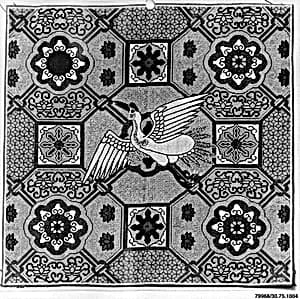
Rank Badge with Manchurian Crane
Unknown Artist
early 19th century
Medium
Silk on canvas
Dimensions
10 1/2 x 11 in. (26.67 x 27.94 cm)
Classification
Textiles-Embroidered
Culture & Period
China · Qing dynasty (1644–1911)
Department
Asian Art
Museum
Metropolitan Museum of Art, New York, NY
Credit
Bequest of William Christian Paul, 1929
Accession Number
30.75.1004
Rights
Public Domain
Tags
Art Historical Context
This exquisite **Rank Badge with Manchurian Crane**, crafted in early 19th-century China during the Qing dynasty (16441911), served as an official insignia worn on the robes of high-ranking civil servants. Square badges like this—known as *biao*—denoted social hierarchy, with the elegant Manchurian crane (red-crowned crane) reserved for first-rank officials. Symbolizing longevity, immortality, and scholarly virtue, the crane embodied Confucian ideals of moral governance and harmony with nature, reflecting the emperor's mandate to rule. Finely embroidered with silk threads on a silk canvas ground, this 10½ × 11-inch textile showcases masterful Qing needlework techniques. Vibrant stitches capture the bird's graceful form, flowing feathers, and poised stance amid stylized clouds and waves, blending realism with symbolic abstraction. Such badges were semi-formal wear, produced in imperial workshops or by skilled artisans, highlighting the era's opulent textile traditions. Now in the Metropolitan Museum of Art's Asian Art Department, thanks to the 1929 be of William Christian Paul, this badge offers a window into Qing bureaucratic splendor. Pause to admire its delicate craftsmanship—a testament to China's enduring artistic legacy.