
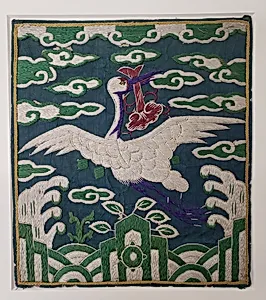
Rank Badge with White Crane
Unknown Artist
late 19th century
Medium
Silk
Dimensions
7 1/2 x 7 in. (19.05 x 17.78 cm)
Classification
Textiles-Embroidered
Culture & Period
Korea · Joseon dynasty (1392–1910)
Department
Asian Art
Museum
Metropolitan Museum of Art, New York, NY
Credit
Seymour Fund, 1953
Accession Number
53.60.8
Rights
Public Domain
Tags
Art Historical Context
This delicate *Rank Badge with White Crane*, crafted in late 19th-century Korea during the Joseon dynasty (1392–1910), exemplifies the refined textile arts of the era. Measuring a modest 7½ x 7 inches, this square embroidered silk patch was designed to be sewn onto the chest of an official's robe, serving as a visible marker of rank in the rigid Confucian bureaucracy. Civil officials wore bird motifs like the crane, distinguishing them from military counterparts who displayed fierce animals. The white crane, rendered with meticulous embroidery stitches in shimmering silk threads, symbolizes longevity, wisdom, and good fortune—auspicious qualities revered in Korean culture. Silk's luxurious sheen and durability made it ideal for such insignia, highlighting the wearer's status while showcasing the anonymous artisan's virtuosic needlework. Techniques likely involved couching, satin, and padding stitches to create texture and depth, transforming a functional object into wearable art. Acquired by The Metropolitan Museum of Art through the Seymour Fund in 1953, this badge offers a glimpse into Joseon society's hierarchical elegance, where every embroidered feather underscored moral and social order. A testament to Korea's enduring textile legacy!