
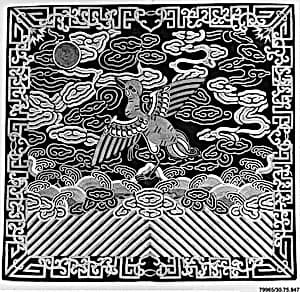
Rank Badge with Wild Goose
Unknown Artist
19th century
Medium
Silk on silk
Dimensions
11 x 11 3/4 in. (27.94 x 29.84 cm)
Classification
Textiles-Embroidered
Culture & Period
China · Qing dynasty (1644–1911)
Department
Asian Art
Museum
Metropolitan Museum of Art, New York, NY
Credit
Bequest of William Christian Paul, 1929
Accession Number
30.75.947
Rights
Public Domain
Tags
Art Historical Context
This exquisite **Rank Badge with Wild Goose**, crafted by an unknown artist in 19th-century Qing dynasty (1644–1911), is a finely embroidered square of silk on silk, measuring 11 x 11¾ inches (27.94 x 29.84 cm). Part of the Metropolitan Museum of Art's Asian collection—thanks to the 1929 bequest of William Christian Paul—it exemplifies the opulent textiles worn by imperial officials. The central motif of a wild goose, rendered in vibrant threads, symbolizes grace and seasonal migration, perched against a subtle background evoking waves or clouds. In Qing bureaucracy, these *buzi's* (rank badges) were mandatory insignia sewn onto the robes of civil and military officials, denoting precise hierarchy. A wild goose typically marked sixth-rank civil servants, bridging mid-level administration; such badges were renewed annually, showcasing the emperor's favor. This piece reflects the era's rigid social order and Confucian ideals of meritocracy amid Manchu rule. The silk-on-silk embroidery technique highlights masterful stitching—couching, satin, and seed stitches—for luminous texture and durability. Worn front and back, these badges blended utility with artistry, offering a glimpse into daily court life. A true treasure for understanding Qing material culture! (198 words)