
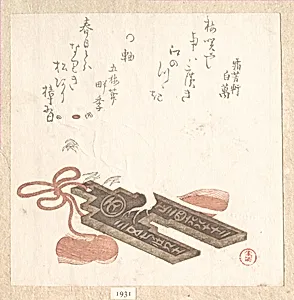
Rat on a Fūchin, Ornament with a Design of Egoyomi (Pictorial Calendar)
1816
Medium
Woodblock print (surimono); ink and color on paper
Dimensions
5 9/16 x 5 1/2 in. (14.1 x 14 cm)
Classification
Prints
Culture & Period
Japan · Edo period (1615–1868)
Department
Asian Art
Museum
Metropolitan Museum of Art, New York, NY
Credit
H. O. Havemeyer Collection, Bequest of Mrs. H. O. Havemeyer, 1929
Accession Number
JP1931
Rights
Public Domain
Tags
Art Historical Context
In the vibrant world of Edo-period Japan (1615–8), Kubo Shunman crafted this delightful woodblock print in 1816, titled *Rat on a Fūchin, Ornament with a Design of EgoyomiPictorial Calendar)*. master of ukiyo-e—the "pictures of the floating world"—Shunman specialized in intimate surimono prints, privately commissioned luxury editions often shared among poetry circles or as New Year's greetings. This small gem, measuring just 5 9/16 x 5 1/2 inches, captures a cheeky rat perched on a fūchin (a shop banner), rendered in vivid ink and color on paper. Surimono like this one frequently featured egoyomi, pictorial calendars that cleverly concealed dates within playful designs, blending art with utility for the literate elite. The rat, a nod to the Chinese zodiac, evokes whimsy and good fortune, common motifs in such seasonal works. Shunman's precise carving and layering techniques produce rich colors and subtle textures, showcasing the woodblock process's ingenuity—blocks inked separately for each hue, then printed in precise registration. Housed in the Metropolitan Museum of Art's Asian Art collection (H. O. Havemeyer Collection, 1929), this print highlights Japan's golden age of printmaking, where everyday symbols like animals became portals to cultural celebration and subtle humor. A charming reminder of art's role in daily rituals!
About the Artist
Kubo Shunman · 1757–1820
Japanese, 1757–1820