
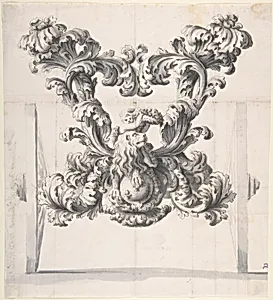
Rear View of an Elaborate Design for a Carriage with Acanthus Leaves and a Putto and Lion on top of a Ball with Three Fleurs-de-Lis
Medium
Pen and brown ink, gray wash, over leadpoint
Dimensions
sheet: 11 1/4 x 10 1/4 in. (28.6 x 26 cm)
Classification
Drawings|Ornament & Architecture
Department
Drawings and Prints
Museum
Metropolitan Museum of Art, New York, NY
Credit
The Elisha Whittelsey Collection, The Elisha Whittelsey Fund, 1952
Accession Number
52.570.202
Rights
Public Domain
Tags
Art Historical Context
This exquisite anonymous drawing from late 17th- to early 18th-century Italy the rear view of an elaborate carriage design, brimming with Baroque opulence. Ornate acanthus leaves frame the composition, while a playful putto (cherub) and a majestic lion perch atop a ball adorned with three fleurs-de-l—symbols evoking royal grandeur and classical antiquity. Created with pen and brown ink, gray wash over leadpoint on a modest 11¼ x 10¼-inch sheet, it exemplifies preparatory sketches for luxury vehicles commissioned by nobility. In the context of Italy's vibrant ornamental tradition during the Baroque era, such designs highlighted the era's love for dramatic, sculptural embellishments on coaches, which served as rolling symbols of status and power. Carriages were not mere transport but spectacles paraded through city streets, blending architecture, sculpture, and fantasy. The lion motif underscores strength and nobility, while acanthus and fleurs-de-lis nod to enduring Renaissance motifs revived in this exuberant style. Housed in the Metropolitan Museum of Art's Drawings and Prints department as part of The Elisha Whittelsey Collection (1952), this work reveals the meticulous craft of anonymous workshop artists. The layered technique—subtle leadpoint underdrawing built up with precise ink lines and atmospheric wash—brings depth and volume, inviting viewers to imagine the gilded reality of the finished carriage rolling through historic European courts.