
Reclining Girl
1925
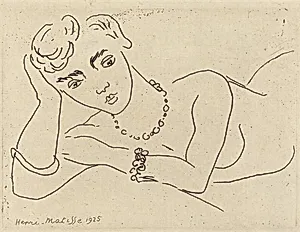
Medium
etching in black on japan paper
Dimensions
plate: 9.2 x 12.1 cm (3 5/8 x 4 3/4 in.) sheet: 24.1 x 19 cm (9 1/2 x 7 1/2 in.)
Classification
Department
CG-W
Museum
National Gallery of Art, Washington, D.C.
Credit
The John U. and Evelyn S. Nef Collection
Accession Number
2011.60.71
Rights
Public Domain
Art Historical Context
Henri Matisse's *Reclining Girl*1925) captures the artist's masterful shift into printmaking during his mature period. A leading figure of Fauvism—known for its vibrant colors and bold forms—Matisse explored the intimate scale of etchings in the 1920s, often depicting reclining female figures with fluid, expressive lines. Created amid the cultural vibrancy of post-World War I Paris, this small-scale work reflects his fascination with the nude form, distilling sensuality into simplified contours that evoke both elegance and vitality. Executed as a black etching on delicate japan paper—a fine, oriental-style sheet prized for its absorbency and texture—this print showcases Matisse's etching technique. The process involves incising lines into a metal plate with acid, allowing for precise, velvety lines that convey movement and depth in just 9.2 x 12.1 cm. The larger sheet (24.1 x 19 cm) frames the intimate image, emphasizing its graphic purity over color. Housed in the National Gallery of Art's CG-W Department as part of The John U. and Evelyn S. Nef Collection, *Reclining Girl* invites visitors to appreciate Matisse's versatility. Far from his colorful paintings, it highlights how prints democratized his vision, bridging fine art and accessibility for 20th-century audiences.
About the Artist
Henri Matisse · 1869–1954
Henri Matisse (1869-1954) was a French painter, draughtsman, printmaker, and sculptor who is widely regarded as one of the most influential artists of the 20th century and the greatest colorist of his era. Born in Le Cateau-Cambresis in northern France, Matisse initially studied law before discovering his passion for art during a period of convalescence at age 20. He became the leading figure of F...