
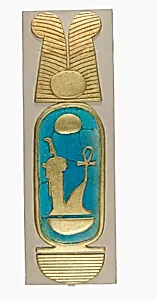
Reconstruction of a Cartouche of Amenhotep III
Unknown Artist
ca. 1390–1352 B.C.
Medium
Faience, modern plaster and gold paint
Dimensions
H. 52.1 cm (20 1/2 in); w. 15.4 cm (6 1/16 in); d. 5.4 cm (2 1/8 in.)
Classification
Tile, cartouche
Period
New Kingdom
Department
Egyptian Art
Museum
Metropolitan Museum of Art, New York, NY
Credit
Rogers Fund, 1917
Accession Number
17.10.1c
Rights
Public Domain
Tags
Art Historical Context
Step into the grandeur of ancient Egypt with this striking *Reconstruction of a Cart of Amenhotep III a testament to the New Kingdom's royal splendor from Dynasty 18 (ca. 1390–1352 B.C.). A cartouche is an ornate oval enclosure bearing the pharaoh's throne name in hieroglyphs, symbolizing the eternal protection of the sun god Re. Amenhotep III, one of Egypt's most prosperous rulers, commissioned vast temples and colossal statues during his reign, marking an era of peace, wealth, and artistic peak. Crafted originally in vibrant faience—a glazed ceramic prized for mimicking semiprecious stones like turquoise—this piece stands about 20 inches tall. Its modern reconstruction with plaster and gold paint revives the luminous effect these inlays once brought to temple walls, palaces, and tombs. Hieroglyphs within the cartouche proclaim the king's divine identity, blending precise carving with symbolic power. Displayed in the Metropolitan Museum of Art's Egyptian Art department (acquired via the Rogers Fund in 1917), this artifact invites us to decode pharaonic legacy. Imagine it gleaming amid Luxor's monuments, whispering of a golden age where art immortalized eternity.