
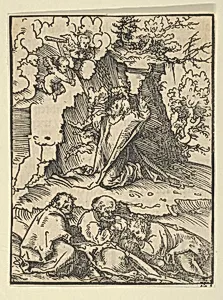
Relief with Christ on the Mount of Olives, from the Wittenberg Reliquaries
Medium
Woodcut
Dimensions
Sheet: 4 5/16 × 3 1/4 in. (11 × 8.2 cm)
Classification
Prints
Department
Drawings and Prints
Museum
Metropolitan Museum of Art, New York, NY
Credit
Harris Brisbane Dick Fund, 1927
Accession Number
27.54.30
Rights
Public Domain
Tags
Art Historical Context
This delicate woodcut, *Relief with Christ on the Mount of Olives, from the Wittenberg Reliquaries*, by Lucas Cranach the Elder, captures a pivotal biblical moment from the New Testament. Created in the Northern Renaissance style, it portrays Christ in the Garden of Gethsemane, surrounded by angels and disciples, moments before his betrayal. Cranach, a prolific German artist (1472–1553) and close ally of Martin Luther, masterminded his Wittenberg workshop to produce prints blending religious devotion with Reformation zeal. As a small-scale relief print (4 5/16 × 3 1/4 in.), this woodcut exemplifies the era's innovative technique: intricate designs carved into wood blocks, inked, and pressed onto paper for affordable dissemination. Produced amid Wittenberg's role as the Protestant epicenter, it likely served devotional purposes, perhaps adorning reliquaries—ornate containers for holy relics—in local churches. Cranach's bold lines and expressive figures made such images accessible, fueling spiritual reflection and Lutheran propaganda. Today, housed in the Metropolitan Museum of Art's Drawings and Prints department (Harris Brisbane Dick Fund, 1927), this piece highlights how printmaking democratized art, bridging elite patronage and everyday piety in 16th-century Europe.
About the Artist
Lucas Cranach the Elder · 1472–1553
Lucas Cranach the Elder (c. 1472-1553) was one of the most prominent German Renaissance painters and a key artistic figure of the Protestant Reformation. Born in Kronach, Franconia, to the painter Hans Maler, Cranach began his career in Vienna around 1502, where he became one of the founders of the Danube School, a movement characterized by expressive landscape painting and emotional force. His ea...